
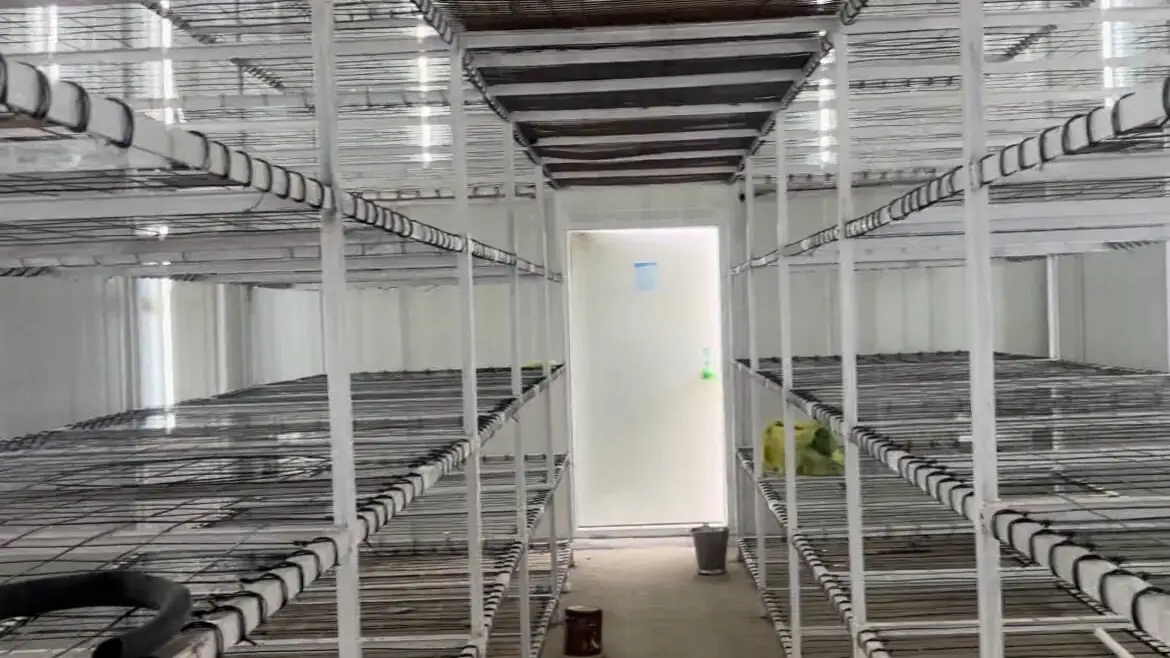
Casing and Pinning SOP — Casing Soil, Ruffling and Flush Initiation — India Setup Procedure & Equipment Cost
Mushroom casing and pinning SOP — casing soil recipe and pasteurisation, 5 cm layer, case run, airing down to 17–18 °C, CO₂ drop for pinning, cost breakdown and free PDF download.
Cultivation SOP — in short
Casing is a 4–5 cm layer of pasteurised, pH 7.5–7.8 soil — usually coco peat with farmyard manure or spent compost plus lime — applied over a fully colonised bed. The mycelium recolonises the casing over 7–10 days at 24–25 °C, is then ruffled, and pinning is triggered by airing down: air temperature to 17–18 °C, CO₂ from above 5,000 ppm to below 1,000 ppm, and RH to 88–92%. Pinheads appear 5–7 days after airing and the first flush is harvested 18–21 days after casing.
Why this procedure matters
Casing does not feed the crop — the nutrition is all in the compost. Casing exists to create a moisture reservoir and a microbial environment that switches the mycelium from vegetative growth to fruiting. Because it is a switch rather than a feed, casing quality is judged on structure and water-holding capacity, not on nutrient content.
The pinning event that follows casing is the most decisive climate operation on the farm. Every square metre of bed sets its pin population within a 48-hour window, and that population determines both the size grade and the total weight of the first flush. Air down too slowly and you get few, large, uneven mushrooms; air down too aggressively and you get a dense carpet of small buttons that stall.
This SOP covers casing soil preparation and pasteurisation, application, case run management, ruffling, and the airing-down sequence with the exact parameter path used in MushroomWale-built rooms.
Step-by-step procedure
1. Casing soil formulation
A reliable Indian mix is 3 parts coco peat to 1 part well-rotted farmyard manure or two-year-old spent compost, with agricultural lime added to bring pH to 7.5–7.8. Coco peat must be washed and low in EC. The finished mix should be crumbly and open, hold water without becoming greasy, and pass a simple structure test: a handful squeezed should hold shape but break apart cleanly when touched.
- pH 7.5–7.8
- EC below 1.0 mS/cm
- Water-holding capacity 65–70%
2. Casing soil pasteurisation
Pasteurise the mixed casing at 65–70 °C for 6–8 hours, either by steam in a tunnel or in bulk under sheets. Unpasteurised casing is the most common route for nematodes, mites and Verticillium (dry bubble) to enter a clean farm. Cool to below 25 °C before application and keep it covered until the moment it goes onto the beds.
- 65–70 °C for 6–8 hours
- Cooled below 25 °C before use
- Stored covered
3. Application
Apply an even 4–5 cm layer over the fully run bed. Even depth is critical: a 3 cm patch will pin days earlier than a 6 cm patch and the flush will lose synchrony. Level with a board rather than by hand-patting, which compacts the surface. Water the casing lightly immediately after application to settle it.
- Depth 4–5 cm
- Depth variation under 0.5 cm
- Surface levelled, not compacted
4. Case run (Day 0 to Day 7–10)
Hold air at 24–25 °C, RH at 92–95% and CO₂ at 5,000–10,000 ppm with minimal fresh air, so the mycelium recolonises the casing. Water in split doses — several light applications rather than one heavy one — totalling roughly 1.0–1.5 litres per square metre over the case run. Heavy single waterings drive water into the compost and cause stroma and bacterial problems.
- 24–25 °C
- RH 92–95%
- CO₂ 5,000–10,000 ppm
- 1.0–1.5 l/sqm total water
5. Ruffling (scratching)
When mycelium has grown two-thirds to three-quarters of the way up through the casing, ruffle the layer with a scratching tool or by hand to break the surface strands and redistribute the mycelium. Ruffling produces a much more even pin set and prevents overlay, where the mycelium mats on the surface and refuses to fruit. Water lightly after ruffling and give 24–48 hours of recovery before airing.
- Ruffle at two-thirds colonisation
- 24–48 hours recovery before airing
6. Airing down — the pinning trigger
Over 24–48 hours, lower air temperature from 24 °C to 17–18 °C, raise the fresh-air fraction to bring CO₂ from above 5,000 ppm to below 1,000 ppm, and settle RH at 88–92%. Do this as a controlled ramp, not a step change: dropping the room in two hours shocks the crop and produces a thin pin set. Compost temperature should follow to 18–19 °C.
- Air 17–18 °C
- CO₂ under 1,000 ppm
- RH 88–92%
- Ramp over 24–48 hours
7. Pinhead formation and selection
Pinheads appear 5–7 days after airing. Hold conditions steady — this is not the time to adjust anything. A healthy set is an even distribution of pins across the whole bed. If the set is too dense, raise CO₂ slightly for 24 hours to thin it; if too sparse, the cause is upstream in casing depth or ruffling and cannot be fixed in this flush.
- Pins visible 5–7 days after airing
- Even distribution across all tiers
8. Through to first harvest
Mushrooms mature 18–21 days after casing. Water between pin set and harvest only lightly, and never onto open pinheads, which causes brown spotting. After the first flush is picked, water more heavily to recharge the casing, and the second flush follows 7–10 days later. Expect three flushes commercially, with roughly 50%, 30% and 20% of total yield.
- First harvest 18–21 days after casing
- Flush interval 7–10 days
Operating parameters
| Parameter | Target | Tolerance | Note |
|---|---|---|---|
| Casing depth | 4–5 cm | ±0.5 cm | Uneven depth desynchronises the flush |
| Casing pH | 7.5–7.8 | ±0.2 | Adjust with agricultural lime |
| Casing pasteurisation | 65–70 °C | 6–8 hours | Blocks nematodes, mites and Verticillium |
| Case run temperature | 24–25 °C | ±1 °C | Same as spawn run |
| Case run RH | 92–95% | ±3% | Casing must never dry out |
| Case run CO₂ | 5,000–10,000 ppm | ±2,000 | Keeps mycelium vegetative |
| Airing air temperature | 17–18 °C | ±1 °C | Ramp over 24–48 hours |
| Pinning CO₂ | under 1,000 ppm | 600–1,000 ppm | The primary fruiting trigger |
| Pinning RH | 88–92% | ±2% | Too high causes sticky caps |
| Case run water | 1.0–1.5 l/sqm | split doses | Never one heavy application |
Daily and per-cycle routine
- Measure casing depth at five points per bed on the day of application and record it.
- Check casing surface moisture by feel every morning; the surface should be damp, never glossy or wet.
- Log air temperature, compost temperature, RH and CO₂ every four hours through airing down.
- Photograph the pin set 48 hours after pins appear — this becomes the reference for comparing cycles.
- Keep casing soil covered in storage and never walk on a casing pile with farm footwear.
- Record the airing-down curve (start time, end time, CO₂ path) against the room and cycle number.
Cost breakdown
What this workstream costs, how each item is measured, and where it sits in the overall project budget.
| Item | Costing basis | Cost band | Note |
|---|---|---|---|
| Coco peat | Per cubic metre or per block | Recurring | Roughly 0.05 cbm per sqm of bed at 5 cm depth |
| Farmyard manure / spent compost | Per tonne | Recurring, low | Must be well rotted; fresh manure ruins casing structure |
| Agricultural lime | Per bag | Recurring, minimal | For pH correction to 7.5–7.8 |
| Casing pasteurisation (steam / tunnel time) | Per batch | Recurring | Shares the Phase-2 steam source on integrated farms |
| Ruffling tool / scratching machine | Per unit | Capital, low | Hand tools at small scale; machine at 10+ rooms |
| Watering system (misting lines, lances) | Per room | Capital | Part of the grow room package in the BOQ |
| Fresh air / CO₂ control (blowers, dampers, sensors) | Per room | Capital | Without CO₂ control the pinning trigger cannot be applied reliably |
| Casing and ruffling labour | Per sqm of bed | Recurring | Labour-intensive; two of the highest man-hour operations in the cycle |
Approx. planning guidance only. Live rates follow the current MushroomWale master rate version; quotations carry 5-day validity and a 5% market volatility clause.
GST @ 18% and Transportation are Extra
Civil works, boundary wall, site levelling, land and power sanction are Client Scope. Any additional work demanded beyond the agreed BOQ is treated as extra and charged separately.
Troubleshooting
| Problem | Likely cause | Corrective action |
|---|---|---|
| No pins forming after airing | CO₂ never dropped below 1,000 ppm, or overlay on the casing surface | Verify the CO₂ sensor against a reference meter and increase fresh air. If the surface is matted white, ruffle lightly and re-air. |
| Stroma — a dense white mat instead of pins | Over-watering into the compost, or casing applied over an over-mature bed | Reduce watering volume and split the doses. Case immediately on full colonisation rather than holding the bed. |
| Pins forming inside the casing, not on the surface | Casing layer too deep or over-compacted | Correct depth to 4–5 cm and level with a board instead of pressing by hand. |
| Brown spots on caps | Water applied directly onto open pinheads, or bacterial blotch from wet surfaces | Stop watering during pin development, increase air movement to dry the cap surface between waterings. |
| Very dense set of tiny buttons that stall | Airing down too fast or too cold | Ramp the temperature and CO₂ over a full 24–48 hours next cycle; raise CO₂ briefly to thin the current set. |
Records to maintain
How this SOP fits mushroom farming setup in India
Mushroom farming setup in India splits into two halves — what you build, and what you run. The build is the insulated grow room, 7-tier racking, refrigeration, fresh-air handling, power and the packhouse. The run is exactly the set of SOPs in this library. The two are locked together: the setpoints in these procedures decide the machine capacity you must buy, and the bed area decides compost tonnage, spawn quantity and achievable yield.
That is why mushroom farming equipment cost can only be estimated once room size, room count, bed area and the site's peak summer temperature are fixed. Any single "cost per room" number quoted without those inputs is misleading — an 18×30 ft room and an 18×60 ft room differ in panel area, racking metres and machine tonnage, and the same room in a hotter district needs a larger machine to hold 16–18 °C during cropping.
The table below shows how each head is measured, so you can sanity-check any quotation you receive. Live rates follow the current MushroomWale master rate version, quotations carry 5-day validity, and GST @ 18% plus transportation are extra.
| Cost head | Measured on | What drives it |
|---|---|---|
| Insulated grow room shell (PUF panels, doors, structure) | Per sq ft of built-up room area | The single largest civil-adjacent head; wall panels 60 mm, roof panels 80 mm, PPGL coated |
| 7-tier MS racking system | Per sq m of bed area | Defines bed area, and therefore compost tonnage, spawn quantity and yield |
| Refrigeration and air handling | Per room, sized on peak summer load | Sized on the location's peak temperature and crop heat load, never on the annual average |
| Fresh air, ducting and controls | Per room | Air cloth duct, mixing chamber, dampers, sensors and the stage-wise controller profile |
| Compost unit (wetting slab and Phase-1 bunkers + Phase-2 tunnel) | Per tonne of batch capacity | Only for integrated farms; grower-only farms buy Phase-2 or Phase-3 compost instead |
| Power infrastructure and DG backup | Per kVA | Sized with starting surge and diversity factor across rooms |
| Packhouse and cold room | Per sq ft + per TR | Pre-cooling to 2–4 °C within 30 minutes is what protects 5–7 day shelf life |
Equipment catalogue
Buy every item used in this SOP
One page with the image, working specification, HSN code, minimum order quantity and live price for each SKU — with a direct buy button. GST and transportation extra.
Download this SOP as a printable PDF
Full procedure, parameter table, cost breakdown, troubleshooting and record sheet — formatted for the farm noticeboard. No form required.
Applying this SOP on your own farm?
Send your details and our project engineer will review your SOP fit, share an itemised cost sheet for your farm size and answer questions on WhatsApp — free.
SOP read: Casing and Pinning SOP — Casing Soil, Ruffling and Flush Initiation (Cultivation)
Frequently asked questions
Other SOPs in this library
Continue the guide series
Why Choose MushroomWale
- 01
Engineering Expertise
Agrimotion Engineering Private Limited is a registered EPC company (CIN U43900UP2023PTC185328, GSTIN 09AAZCA0158R1ZP) based in Firozabad, Uttar Pradesh.
- 02
Proven Track Record
Turnkey mushroom projects from a 2-room starter to a 20-room commercial farm.
- 03
Bank-Recognized DPRs
Bank-format DPRs prepared to NABARD, NHB and MIDH norms for loan and subsidy applications.
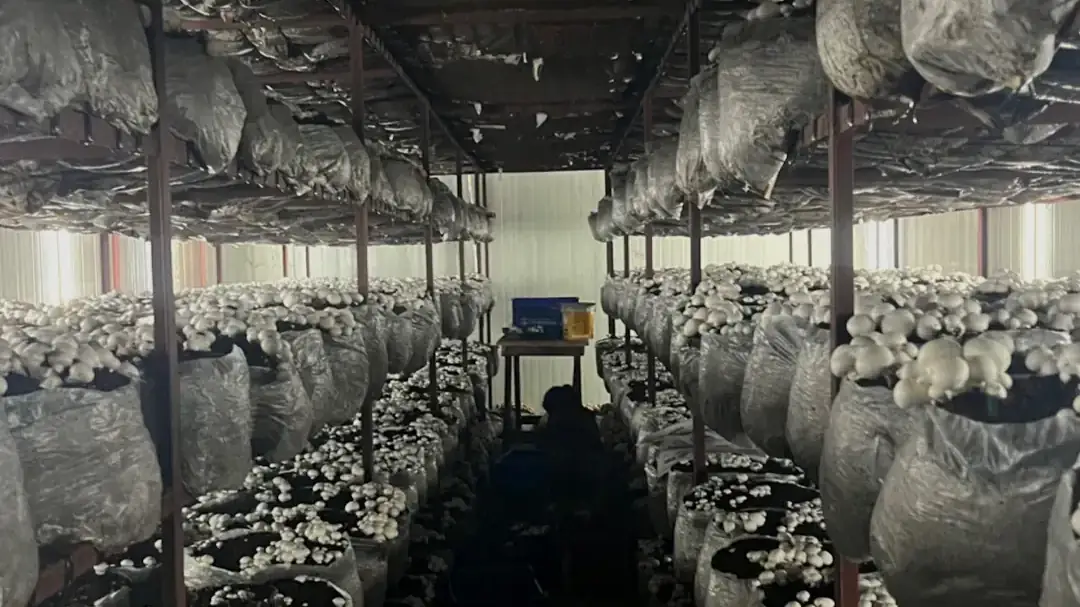
Ready to Build Your Mushroom Farm?
Get a free site survey and a custom quote within 24 hours.
- Turnkey farms built
- Pan-India delivery
- Bank-ready DPR