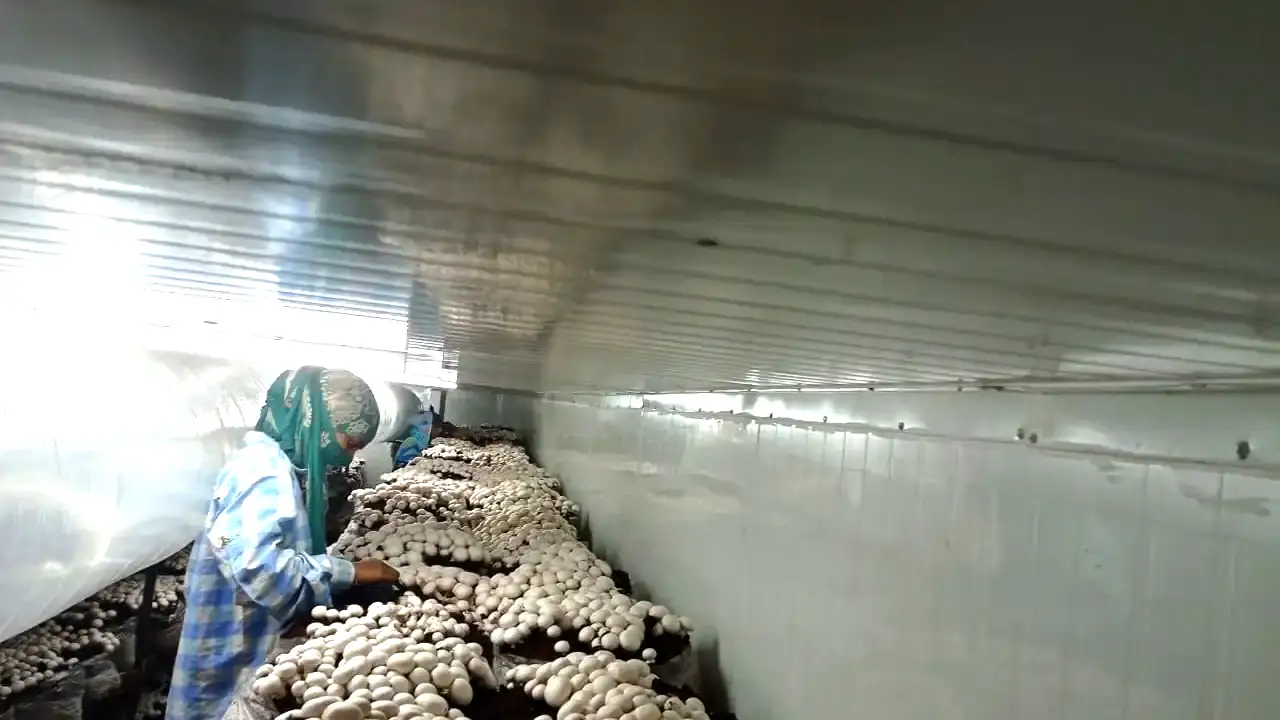
बटन मशरूम की व्यावसायिक खेती के हर पहलू पर 42 विस्तृत लेख—कम्पोस्ट साइंस से लेकर बाज़ार की रणनीतियों तक।
42
एक्सपर्ट लेख
7
कैटेगरी
मुफ्त
एक्सेस
अपडेटेड
नियमित
01
Getting Started with Button Mushroom Farming
Essential fundamentals for beginners entering commercial mushroom cultivation
6
BeginnerOverview
What is Button Mushroom?
Agaricus bisporus - the world's most cultivated edible mushroom
Button mushroom (Agaricus bisporus) is the world's most cultivated edible mushroom. Native to Europe and North America, it's now cultivated worldwide. India produces 180,000+ tonnes annually. Three stages: button (white cap closed), crimini (brown), portobello (mature). Highly nutritious with protein (3.1g/100g), fiber, vitamins B2, B3, D, and selenium.
BusinessROI
Why Start Mushroom Farming?
Market opportunity, ROI potential, and government support
Indian mushroom market: ₹2,800+ crore (2024). On the site's cost model (₹120/kg farm gate, 6 crops a year) two 18×40 ft rooms on bought-in compost pay back their quotation in about 32 months, and four rooms with their own compost unit in about 20 months. High demand from hotels, restaurants, retail chains. Government support: MIDH pays 40% of cost norms (50% in NE and Himalayan states), or NHB by capacity — never both; NABARD refinances loans but pays no subsidy. Year-round indoor cultivation possible. Low land requirement compared to traditional farming.
TechnicalClimate
Climate Requirements
Temperature, humidity, CO₂, and light parameters for each growth stage
Spawn Run: 22-24°C air (compost 24-25°C), 90-95% RH, 5,000-15,000 ppm CO₂, no light. Case Run: 24-25°C, 92-95% RH, 5,000-10,000 ppm CO₂. Pinning: air down to 17-18°C over 24-48 hours, 88-92% RH, CO₂ under 1,000 ppm. Cropping: 16-18°C, 85-90% RH, CO₂ under 1,000 ppm, diffused light optional. Temperature precision is critical - even a ±1°C drift affects yield.
BusinessInvestment
Investment Breakdown
Detailed cost structure for starting a mushroom farm
Rooms, not bags, set the cost. One 18×30 ft room (1,000 bags) is ₹6.6–9.0 lakh, one 18×70 ft room (3,000 bags) ₹11.9–17.4 lakh, two 18×70 ft rooms (6,000 bags) ₹21.8–32.8 lakh — MushroomWale EPC core to full scope, ex-GST; civil works, land and working capital are extra. A 3,000-bag crop gives about 6,000 kg, ₹7.2 lakh at ₹120/kg. Running cost is about 79% of sales on bought-in compost (₹94.4/kg) and 61% with an own compost unit (₹73.6/kg).
PlanningInfrastructure
Site Selection Criteria
Choosing the right location for your mushroom farm
Requirements: Clean water source, 3-phase electricity, road access, away from chemical factories. Ideal: 0.5-2 acres land. Avoid: Flood-prone areas, high pollution zones, near livestock farms. Climate preference: Cooler regions reduce AC costs. Urban proximity: Better market access but higher land cost. Consider: Labor availability, raw material sourcing, waste disposal options.
WarningBest Practices
Common Mistakes to Avoid
Critical errors that lead to crop failure and financial loss
Top failures: 1) Poor hygiene (the main source of contamination), 2) Wrong temperature management, 3) Inadequate fresh air exchange, 4) Using old/contaminated spawn, 5) Improper casing moisture, 6) Overcrowding bags, 7) Ignoring Phase II conditioning, 8) Harvesting too late (spore release), 9) Poor cold chain, 10) Skipping training before starting. Any one of these can cost a crop.
02
Composting Science (Day 0-16)
Master the art and science of mushroom compost preparation
6
MaterialsFormula
Raw Materials & Formulation
Ingredients, quantities, and quality parameters for compost
Base formula per tonne: Wheat straw 1000kg, Poultry manure 350-400kg, Urea 15kg, Gypsum 40kg, Wheat bran 50kg. C:N ratio target: 30-33:1. Straw quality: Golden color, no black spots, 8-10% moisture. Poultry manure: Fresh, high nitrogen (2-3% N). Supplements: Molasses, ammonium sulfate optional. Water quality: pH 6.5-7.5, TDS <500 ppm.
ProcessPhase 0
Pre-wetting Protocol (Day 0-3)
Initial moisture management and stack preparation
Day 0: Spread straw, add supplements dry. Day 1: First watering to 65% moisture, add poultry manure. Day 2: Continue wetting, turn once, target 68-70% moisture. Day 3: Final moisture adjustment to 72%, fill the aerated bunkers 6-7ft high. Squeeze test: 8-10 drops water from handful. Pre-wetting on the wetting slab: concrete sloped 2 in (20 T unit) / 4 in (30 T unit) along its length, with drainage. Duration: 72 hours minimum.
Phase IFermentation
Phase I Composting (Day 3-9)
Outdoor bunker fermentation with turning schedule
Bunker dimensions: 14×30ft or 14×40ft. Fill height: 6-7ft. Core temperature target: 70-78°C. Turning schedule: filled on Day 3, turned on Day 3, Day 5 and Day 7, out to the tunnel on Day 9. Blower operation: 5-10 minutes every 2 hours. Aeration: 8-inch HDPE manifold, 4-inch PVC underfloor. Ammonia at exit: strong, as Phase 1 should be; Phase-2 conditioning brings it under 10 ppm. Color change: Golden → brown. Duration: Day 3-9 (6 days).
Phase IICritical
Phase II Pasteurization (Day 9-15)
Tunnel conditioning for pathogen elimination and selectivity
Pasteurization: 58-60°C for 6-8 hours, never above 62°C (kills pathogens, weed seeds, nematodes). Conditioning: 45-50°C for 4-6 days (ammonia removal, beneficial microbe growth). Exit parameters: Ammonia under 10 ppm, pH 7.2-7.5, moisture 68-70%, dark brown color, sweet earthy smell. Tunnel: Insulated, sealed doors, 10 HP blower, steam generator optional.
QualityTesting
Compost Quality Testing
How to assess if your compost is ready for spawning
Physical: Dark brown color, no ammonia smell, holds shape when squeezed. Chemical: pH 7.0-7.5, N content 2-2.2%, C:N ratio 17-18:1, moisture 68-70%. Bioassay: 70% mycelium coverage in 7 days with good spawn. Red flags: Ammonia smell (>5 ppm), green/black mold, sour smell (anaerobic), dry patches (<65% moisture), sticky texture (>75% moisture).
Complete grow room management from spawning to harvest
6
SpawnQuality
Spawn Selection & Storage
Choosing quality spawn and proper handling
Types: Grain spawn (wheat/rye - preferred), Sawdust spawn. Quality indicators: White fluffy mycelium, no wet spots, sweet smell, <2 weeks old. Storage: 2-4°C refrigerated, use within 15-20 days. Spawn rate: 0.5-0.7% of wet compost weight (50-70g per 10kg bag). Suppliers: ICAR-DMR Solan, TNAU, private certified labs. Never use spawn with green/black contamination.
SpawningTechnique
Bagging & Spawning Technique
Proper method for filling bags and spawn mixing
Bag size: 45×90cm polypropylene, 10-12kg compost/bag. Spawning methods: Through mixing (uniform distribution), Layer spawning (3 layers). Room preparation: Clean, disinfect with formaldehyde 48hrs before. Spawning temperature: Compost at 25°C (24-26°C, never above 27°C). Process: Mix spawn uniformly, fill bags loosely, make 4-6 holes (1cm dia), place on racks. Capacity: 160-200 bags per rack level.
Spawn RunColonization
Spawn Run Management (Day 0-18)
Mycelium colonization period and optimal conditions
Temperature: 22-24°C air, compost held at 24-25°C (critical for fast colonization). RH: 90-95% (prevent drying). CO₂: 5,000-15,000 ppm acceptable. Air exchange: Minimal (1-2 changes/day). Light: Not required. Duration: about 14 days (12-16) for full colonization. Signs of progress: White mycelium spreading from spawn points. Avoid: Opening bags, temperature fluctuations, excess moisture. Full colonization = white mycelium throughout bag.
CasingCritical
Casing Application (Day 18-20)
Casing layer preparation, pasteurization, and application
Casing mix: Peat moss 70% + Garden loam 30% OR Coco peat + Vermicompost. Treatment: Steam pasteurization at 65-70°C for 6-8 hours OR Chemical (formaldehyde soak). pH adjustment: 7.5-7.8 using calcium carbonate. Moisture: 70-75% (squeeze test: few drops). Thickness: 4-5cm uniform layer. After casing: a 7-10 day case run at 24-25°C and 92-95% RH. Scratching: Lightly break surface on Day 7-8.
PinningCritical
Pinning & Case Run (Day 20-30)
Triggering mushroom primordia formation
Airing: bring the air down to 17-18°C over 24-48 hours. CO₂ reduction: under 1,000 ppm (increase fresh air). RH: 88-92%. Light: Optional diffused light helps. Pin formation: Small white dots on casing surface, 5-7 days after airing. Critical: Maintain conditions consistently - fluctuations abort pins. Common failures: High CO₂, temperature spikes, dry casing, contamination. Healthy pins = even distribution across surface.
CroppingClimate
Cropping Climate Control (Day 30-60)
Optimal environment during mushroom production phase
Temperature: 16-18°C (lower = firmer mushrooms, higher = faster but softer). RH: 85-90% (misting 2-4 times daily). CO₂: under 1,000 ppm (higher = longer stems). Air velocity: 0.1-0.3 m/s (avoid direct draft on beds). Watering: Light misting, never wet mushroom caps. Cooling: Daikin cassette AC, insulated ducting. Energy target: ₹3-4/kg production cost. Duration: about 4 weeks, first pick 18-21 days after casing, 3 flushes 7-10 days apart.
04
Harvesting & Post-Harvest
Maximize quality and shelf life through proper handling
6
FlushesYield
Flush Management
Understanding and optimizing harvest cycles
Flush 1 (Day 35-42): 50% of total yield, largest mushrooms. Flush 2 (Day 45-52): 30% yield, good quality. Flush 3 (Day 55-62): 20% yield, smaller size. Flush 4: Optional, often skipped. Between flushes: Remove stumps, light watering, maintain temperature. Total yield target: 2kg per 10kg bag (20% biological efficiency). Higher flushes indicate good compost and management.
HarvestQuality
Harvest Timing & Technique
When and how to pick for maximum quality
Optimal stage: Veil intact (just before breaking), cap 3-5cm diameter. Technique: Twist and pull gently (don't cut - leaves stump). Timing: Early morning and evening (cooler, firmer). Frequency: 2-3 times daily during peak. Grades: A (3-4cm, closed), B (4-5cm, closed), C (>5cm, partial veil break). Reject: Open caps (spore release), diseased, damaged. Handle minimally - each touch reduces shelf life.
Cold ChainStorage
Post-Harvest Cooling
Critical cold chain for quality preservation
Field heat removal: Within 30 minutes of harvest. Pre-cooling: Cold room at 2-4°C, 90% RH. Target core temp: 4°C within 2 hours. Avoid: Washing (promotes bacterial growth), stacking (bruising). Shelf life at 4°C: 5-7 days. At room temperature: 1-2 days only. Cold room capacity: 1 day's harvest × 7 days storage. Investment in cold chain prevents post-harvest losses.
PackagingMarketing
Packaging Standards
Consumer and bulk packaging options
Retail punnets: 200g, 400g with cling wrap + tray. Bulk packs: 5kg, 10kg cardboard boxes with ventilation. Labeling: Weight, date, farm name, storage instructions. Modified atmosphere: CO₂ 5-10%, O₂ 5-10% extends life 3-5 days. Premium packaging: Vacuum-sealed for export. Never mix grades in same pack. Transport: Refrigerated vehicle 2-4°C. Quality grading at packing: Consistency builds buyer trust.
SalesBusiness
Market Channels
Where and how to sell your mushroom produce
Direct retail: Farmer markets, local shops (best margins). HORECA: Hotels, restaurants, caterers (bulk, regular orders). Wholesale: APMC mandis, commission agents (lower margins but volume). Modern retail: Supermarkets, BigBasket, Amazon Fresh (quality standards, delayed payment). Processing: Dried, canned, frozen (value addition). Export: Fresh to Middle East, dried to EU/US. Build multiple channels to reduce risk.
ProcessingValue Add
Value-Added Products
Processing options for mushroom by-products
Dried mushrooms: 10:1 ratio, ₹800-1200/kg dried. Mushroom powder: Health supplements, instant soups. Pickles & preserves: Regional delicacy, long shelf life. Frozen: IQF for export, food service. Spent compost: Excellent organic fertilizer, vermicompost input. Casing reuse: After pasteurization, limited reuse possible. Value addition increases revenue by 2-5x vs fresh sales.
05
Disease & Pest Management
Identify, prevent, and manage crop health issues
6
DiseaseCritical
Green Mold (Trichoderma)
Most common competitor - identification and control
Identification: Green patches on compost/casing, spreads rapidly. Causes: Poor Phase II, contaminated spawn, poor hygiene, high temperature. Prevention: Proper pasteurization, quality spawn, strict hygiene, temperature control. Treatment: Remove affected bags immediately, apply salt on spots, reduce humidity temporarily. Severe outbreak: May need to terminate crop. Green mold is indicator of process failure - fix root cause.
DiseaseFungal
Wet Bubble (Mycogone)
Fungal disease causing deformed mushrooms
Symptoms: Distorted mushrooms, amber liquid droplets, white fluffy growth. Spread: Airborne spores, contaminated casing, water splash. Prevention: Casing pasteurization, controlled humidity, air filtration. Treatment: Remove infected mushrooms with tissue, increase ventilation, apply fungicide (Bavistin 0.1%) carefully. Avoid overhead watering. Sanitation between crops is essential.
DiseaseFungal
Dry Bubble (Verticillium)
Common fungal disease causing brown discoloration
Symptoms: Brown spots on caps, split stems, dry brown lesions. Distinguishing: Dry surface (vs wet bubble's amber drops). Causes: Contaminated casing, spore spread, poor air filtration. Prevention: Quality casing material, HEPA filtration, hygiene protocols. Treatment: Remove affected mushrooms, salt application, reduce humidity. Lower severity than green mold or wet bubble but reduces quality significantly.
Nematodes: Cause wet, slimy mushrooms with fishy smell. Source: Contaminated compost, poor pasteurization. Prevention: Proper Phase II temperatures. Mites: Tiny spider-like creatures causing pitting and browning. Types: Mushroom mites (Tyrophagus), Red pepper mites. Control: Steam treatment between crops, acaricides (limited options). Key: Clean-out protocols after each crop cycle.
IPMStrategy
Integrated Pest Management
Comprehensive prevention and control strategy
Foundation: Hygiene, hygiene, hygiene - most problems are preventable. Physical: Air filtration, positive pressure, sealed rooms. Cultural: Crop rotation, clean-out between cycles, quality inputs. Biological: Beneficial microbes in compost, biocontrol agents. Chemical: Last resort, rotate modes of action. Monitoring: Regular inspection, record-keeping, early detection. IPM reduces chemical use while improving crop health.
06
Equipment & Infrastructure
Technical specifications for grow rooms and compost units
6
ConstructionSpecs
Grow Room Construction
Building specifications for optimal cultivation environment
Dimensions: 18×40ft (1600 bags), 18×60ft (2500 bags), 18×70ft (3000 bags). Walls: 80mm PPGL PUF panels (polyurethane foam insulation with PPGL coating - Much Better than PPGI). Floor: RCC 4-inch with epoxy coating. Height: 16ft front, 14ft back (for drainage). Racks: MS angle iron, 7 levels × 5ft wide × 3ft walkway. Doors: Insulated, airlocks preferred. Windows: None (controlled environment). Orientation: East-West for minimal heat gain.
ClimateEquipment
Climate Control Systems
AC, ventilation, and humidity equipment specifications
Cooling: Daikin systems - 6 TR/1 outdoor (18×30), 8 TR/2×4 outdoor (18×40), 10 TR/4+6 outdoor (18×60), 12 TR/2×6 outdoor (18×70). Insulated ducting: 10-12 inch diameter, uniform distribution. Fresh air: Motorized dampers, HEPA filtration. Recirculation: 25-30 air changes/hour during cropping. Humidity: Ultrasonic foggers or high-pressure misting (50-70 bar). Control: PLC automation with temperature, RH, CO₂ sensors. Energy efficiency: VFDs on fans, night-time cooling.
CompostInfrastructure
Compost Unit Design
Bunker and tunnel specifications for compost production
Bunker: 14×30ft or 14×40ft, 8ft walls, RCC construction. Floor: 6-8 inch concrete, 2% slope to drain. Aeration: 8-inch HDPE manifold, 4-inch PVC laterals with spigots. Blowers: 3.5-5 HP per bunker, 7.5-10 HP per tunnel. Tunnel: Same dimensions, fully insulated, sealed doors. Steam line: Optional for Phase II pasteurization. Wetting and mixing slab: 45×50 ft (20 T) / 45×70 ft (30 T) concrete with water supply, sloped 2 in / 4 in along its length.
UtilitiesPlanning
Water & Electrical Systems
Utilities planning for mushroom farm operations
Water: 50,000-100,000 liters/day for 3000-bag unit. Storage: Overhead tank + sump. Treatment: RO if TDS >500 ppm. Piping: CPVC, avoid metal. Electrical: 3-phase, 100-200 kVA load. Backup: Diesel generator essential. UPS: For controllers and sensors. Earthing: Proper grounding for safety. Solar: can offset part of the fan and lighting load.
AutomationIoT
Automation & Monitoring
Smart farming technology for precision cultivation
Sensors: Temperature (±0.1°C), RH (±2%), CO₂ (NDIR type). Controllers: PLC-based, 4-20mA inputs, relay outputs. SCADA: Real-time monitoring, data logging, alarms. Remote access: Mobile app for alerts and control. Climate algorithms: Automated stage-based climate recipes. Benefits: better yields, reduced labor, consistent quality. Investment: ₹2-5 lakhs for comprehensive system.
MaintenanceOperations
Maintenance Protocols
Equipment care and preventive maintenance schedules
Daily: Check temperatures, RH readings, equipment operation. Weekly: Clean filters, check misting nozzles, inspect racks. Monthly: AC service, blower belt tension, electrical connections. Quarterly: Deep cleaning between crops, paint touch-up, seal inspection. Annually: Major AC service, structural inspection, calibration. Keep maintenance logs. Downtime during crop = significant loss. Spare parts inventory essential.
07
Business & Compliance
Licenses, subsidies, and business management
6
SubsidyGovernment
Government Subsidies
Available schemes and how to apply
MIDH: 40% of fixed cost norms (50% in NE and Himalayan states) — up to ₹12 lakh on a production unit, ₹12 lakh on a compost unit, ₹8 lakh on a spawn unit. NHB (instead of MIDH, for units above 50 MT): 35% of ₹75,000 per tonne; NHB cold storage 35%, capped at ₹2 crore. NABARD: no subsidy — it refinances bank term loans. PMFME: 35% credit-linked subsidy for processing, up to ₹10 lakh. State schemes: confirm with the district horticulture officer before counting them. APEDA: export assistance, quality certification. Application: DPR, bank tie-up, inspection, back-ended release. Documentation is key — every figure is cited on our subsidy page.
LegalCompliance
Licenses & Registrations
Required permits for mushroom farming business
Mandatory: GST registration (if turnover >₹40 lakhs), FSSAI license (food business). Recommended: APEDA registration (for export), Organic certification (premium pricing). State-specific: Horticulture department registration, pollution NOC. Company formation: Proprietorship/Partnership/Pvt Ltd based on scale. Bank account, PAN, proper bookkeeping from Day 1. Compliance saves future headaches.
FinanceManagement
Financial Management
Cash flow, costing, and profitability tracking
Working capital: 3-month operating expenses buffer. Cost tracking: Per kg production cost (target ₹35-45/kg with self-made compost, ₹55-75/kg with purchased). Revenue recording: By channel, by grade, by customer. Break-even analysis: Bags/month needed to cover fixed costs. Margin analysis: Gross and net margin, tracked every cycle. Cash flow: Irregular harvest = irregular income. Maintain reserves. Use accounting software from start.
DPRPlanning
Project Report (DPR)
Preparing detailed project report for loans and subsidies
Contents: Executive summary, promoter background, project description, technical details, cost estimates, means of finance, projected P&L, cash flow, break-even. Format: Follow NABARD/bank format. Assumptions: Conservative yield estimates, realistic pricing. Supporting: Quotations, land documents, KYC. Review: Get banker's feedback before submission. Timeline: 2-4 weeks for preparation. Cost: ₹10,000-50,000 for consultant-prepared DPR.
Phase 1: Single unit profitability, process standardization. Phase 2: Add capacity (rooms) with same compost unit. Phase 3: Second compost unit for 6000+ bags. Phase 4: Processing facility for value addition. Phase 5: Contract farming, training center. Key metrics for scaling: >85% capacity utilization, <5% contamination, stable quality, reliable team. Don't scale before standardizing current operations.
शुरू करने के लिए तैयार?
ज्ञान को एक्शन में बदलें
हमारे कैलकुलेटर से अपने प्रोजेक्ट की प्लानिंग करें या एक्सपर्ट टीम से कस्टमाइज़्ड कोटेशन पाएं।