
Spawning and Spawn Run SOP — Dosage, Filling and Colonisation — India Setup Procedure & Equipment Cost
Mushroom spawning and spawn run SOP — 5–7.5 kg spawn per tonne, 90–100 kg/sqm fill, 24–25 °C compost, contamination checks, cost breakdown and free PDF.
Cultivation SOP — in short
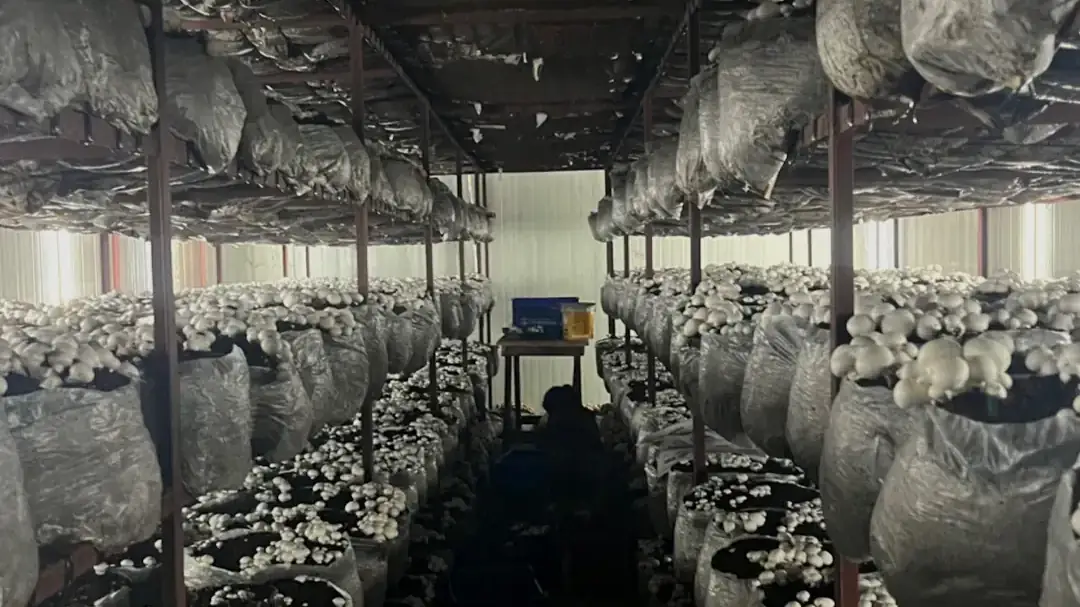
Spawn is mixed into Phase-2 compost at 0.5–0.75% of wet compost weight (5–7.5 kg per tonne), filled at 90–100 kg per square metre of bed on 7-tier racks, and colonised for 12–16 days. Hold compost temperature at 24–25 °C, air temperature at 22–24 °C, relative humidity at 90–95% and CO₂ between 5,000 and 15,000 ppm with minimal fresh air. Spawn run is complete when white mycelium is visible throughout the bed and reaches the polythene or bed surface.
Why this procedure matters
Spawning is the shortest phase of the crop and the one with the least margin for error. Everything that follows — casing, pinning, flush uniformity, total yield — is set during the twelve to sixteen days of the spawn run. A bed that colonises unevenly will pin unevenly, and no amount of climate control afterwards will correct it.
The objective is simple: give Agaricus bisporus mycelium an uncontested head start over every competing organism in the room. That means clean compost, clean hands, correct dosage, uniform mixing, correct bed density, and a stable temperature. Competitors thrive in exactly the conditions that stress Agaricus — high temperature, high moisture and stagnant air — so the SOP is built around holding the room steady rather than intervening.
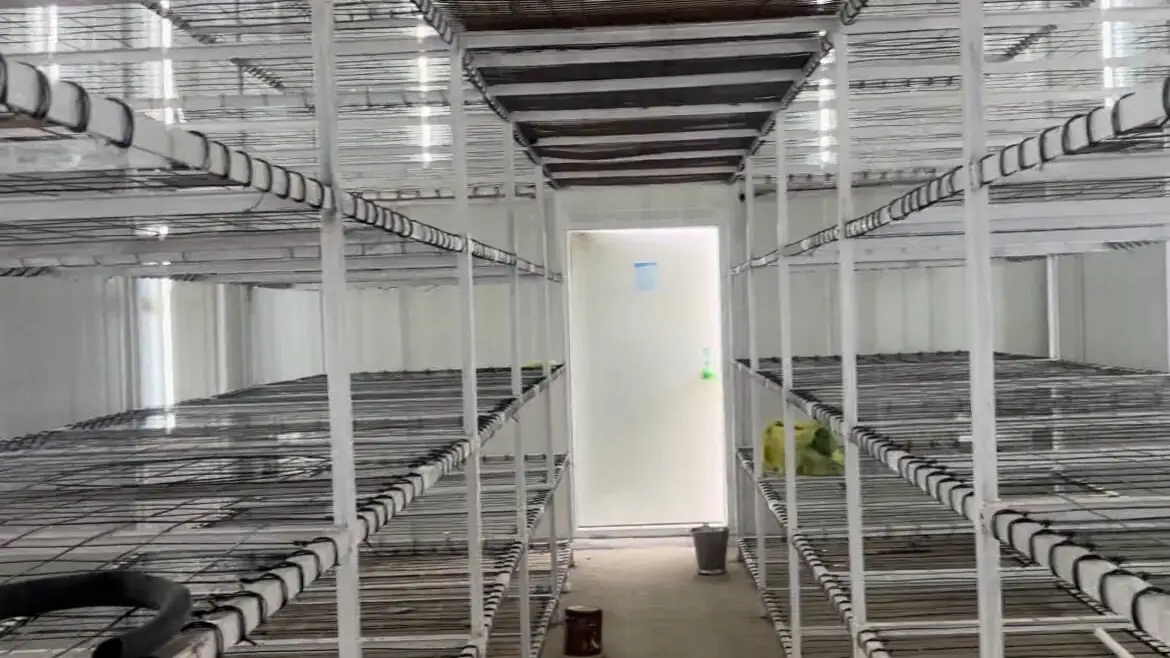
This procedure assumes climate-controlled PUF grow rooms with 7-tier MS racking, which is the standard MushroomWale build for Indian conditions. Farms running seasonal sheds can follow the same parameter targets but should expect wider swings and lower biological efficiency.
Step-by-step procedure
1. Room preparation before compost arrives
Wash the room, racks and floor with detergent, rinse, then disinfect with 2% formalin or a quaternary ammonium disinfectant. Cook-out the empty room at 65–70 °C for 8–12 hours if the previous crop had disease. Close the room and let it stabilise at 25 °C for 24 hours before filling. Check that door seals, drain traps and filter housings are intact — an open drain trap is a direct pathway for flies.
- Room disinfected within 24 hours of filling
- Cook-out at 65–70 °C after any diseased crop
2. Spawn receipt, inspection and storage
Buy grain spawn from a certified lab only. On receipt, inspect every bag: healthy spawn is uniformly white, smells of fresh mushroom, and shows no green, black or pink patches and no wet or slimy grain. Reject any bag showing off-colour. Store at 2–4 °C and use within 15 days of manufacture. Bring spawn to room temperature two hours before spawning — cold spawn added to warm compost condenses moisture on the grain and stalls the run.
- Storage at 2–4 °C
- Use within 15 days
- Zero contaminated bags accepted
3. Spawn dosage calculation
Dose at 0.5–0.75% of wet Phase-2 compost weight, which is 5–7.5 kg of grain spawn per tonne. Use the higher end in winter, on a first crop in a new room, or where the compost is slightly cooler than ideal, because a higher dose colonises faster and gives competitors less time. Weigh the spawn — never estimate by bag count, because bag fill weights vary between labs.
- 5–7.5 kg spawn per tonne of compost
- Weighed, not estimated
4. Mixing and filling
Mix spawn through the full compost mass, not just the top layer. Machine mixing on a spawning line is ideal; hand spawning must be done in two passes with the compost turned between them. Fill the beds to 18–20 cm depth at 90–100 kg per square metre, level the surface, and press lightly to a firm but not compacted finish. Uniform depth across all seven tiers matters more than the exact figure, because temperature and airflow differ tier to tier already.
- Bed depth 18–20 cm
- 90–100 kg compost per sqm of bed
- Depth variation under 2 cm
5. Sealing and the first 72 hours
Cover the beds with perforated polythene if the farm uses the sheet method, or maintain high humidity in the room if not. For the first 72 hours, hold compost temperature at 25 °C and do not open the room except for the daily inspection. This is when the mycelium establishes; every door opening drops humidity and pulls the surface dry.
- Compost 24–25 °C
- RH 90–95%
- Minimum door openings
6. Managing the colonisation heat load
From Day 4 the mycelium generates its own heat, and compost temperature will run 2–3 °C above air temperature. Lower the air temperature to hold compost at 24–25 °C — do not let compost exceed 28 °C, which kills mycelium and favours competitors. This is the single most common spawn-run failure on Indian farms during April to June, and it is why refrigeration is sized on peak ambient rather than average.
- Compost never above 28 °C
- Air temperature 22–24 °C
- Delta held by machine, not by opening doors
7. Daily inspection and contamination response
Inspect every bed daily with a torch. Healthy mycelium is bright white, cottony and advancing evenly. Green (Trichoderma), olive-brown (Chaetomium), or pink patches must be dealt with immediately: cover the patch with salt or lime, mark it, and record it. Do not disturb the patch or brush it — spores go airborne and reach every rack in the room.
- Daily torch inspection of all tiers
- Same-day response to any contamination
8. Spawn run completion and handover to casing
Spawn run is complete when white mycelium is visible throughout the bed depth and has reached the surface — typically 12–16 days. Confirm by opening a small section at three points per room. Do not case early: an incompletely run bed cased over will produce a weak, delayed and uneven first flush. Record the completion date and the observed uniformity before handing the room over to the casing SOP.
- Full colonisation in 12–16 days
- Verified at 3 points per room
Operating parameters
| Parameter | Target | Tolerance | Note |
|---|---|---|---|
| Spawn rate | 0.6% | 0.5–0.75% | Of wet Phase-2 compost weight |
| Compost temperature at spawning | 25 °C | 24–26 °C | Never spawn above 27 °C |
| Compost temperature during run | 24–25 °C | max 28 °C | Self-heating adds 2–3 °C over air |
| Air temperature | 22–24 °C | ±1 °C | Lowered as the heat load rises |
| Relative humidity | 90–95% | ±3% | Prevents surface drying |
| CO₂ | 5,000–15,000 ppm | up to 20,000 ppm | High CO₂ favours vegetative growth |
| Bed depth | 18–20 cm | ±2 cm | Uniformity matters more than the absolute figure |
| Fill density | 90–100 kg/sqm | ±5 kg | Basis for compost quantity in the BOQ |
| Spawn run duration | 14 days | 12–16 days | Longer with low dose or cool compost |
Daily and per-cycle routine
- Record compost temperature at three tiers (top, middle, bottom) and both ends of each room twice daily.
- Log air temperature, RH and CO₂ every four hours from the controller or datalogger.
- Torch-inspect every bed once daily and photograph anything abnormal.
- Change footwear at the room entrance and use a fresh disinfectant foot dip per room.
- Keep a spawn traceability log: lab name, batch number, manufacture date, quantity used per room.
- Never move staff from a contaminated room into a clean room on the same shift.
Cost breakdown
What this workstream costs, how each item is measured, and where it sits in the overall project budget.
| Item | Costing basis | Cost band | Note |
|---|---|---|---|
| Grain spawn | Per kg, 5–7.5 kg per tonne of compost | Recurring | Certified lab spawn only; cheap spawn is the most expensive saving on a mushroom farm |
| Phase-2 compost (bought or made) | Per tonne | Largest recurring cost | 90–100 kg per sqm of bed area |
| 7-tier MS racking | Per kg of MS angle and MS jali | Capital, scales with bed area | Costed on total bed area, not room count |
| Polythene sheets / bed covers | Per sqm of bed | Recurring, low | Replaced every few cycles |
| Room disinfection consumables | Per room per cycle | Recurring, low | Formalin or QAC, foot dips, gloves, masks |
| Spawning labour | Per tonne filled | Recurring | Machine spawning lines reduce this significantly at scale |
| Cook-out steam | Per room per cycle | Recurring | Only where a steam source exists; otherwise chemical disinfection |
Approx. planning guidance only. Live rates follow the current MushroomWale master rate version; quotations carry 5-day validity and a 5% market volatility clause.
GST @ 18% and Transportation are Extra
Civil works, boundary wall, site levelling, land and power sanction are Client Scope. Any additional work demanded beyond the agreed BOQ is treated as extra and charged separately.
Troubleshooting
| Problem | Likely cause | Corrective action |
|---|---|---|
| Spawn does not run at all | Free ammonia in compost, compost too wet, or dead spawn | Test ammonia and moisture immediately. If ammonia is above 10 ppm the batch is lost — record it against the compost SOP and correct conditioning next batch. |
| Patchy colonisation | Uneven mixing or uneven bed depth | Nothing can be corrected mid-run. Change to two-pass mixing and re-check fill depth on the next batch. |
| Green mould spreading across beds | Under-pasteurised compost or dirty room | Salt or lime the patches, isolate the room, complete the cycle without moving staff between rooms, then cook out at 65–70 °C before refilling. |
| Compost temperature climbing past 28 °C | Refrigeration undersized or airflow blocked | Increase cooling and check that return-air paths between tiers are clear. If the machine is at full duty, the room is over-filled for its capacity. |
| Surface of the bed dried out and crusted | Low RH or over-frequent door openings | Raise RH to 95%, restrict entry to one inspection per day, and mist lightly — do not soak. |
Records to maintain
How this SOP fits mushroom farming setup in India
Mushroom farming setup in India splits into two halves — what you build, and what you run. The build is the insulated grow room, 7-tier racking, refrigeration, fresh-air handling, power and the packhouse. The run is exactly the set of SOPs in this library. The two are locked together: the setpoints in these procedures decide the machine capacity you must buy, and the bed area decides compost tonnage, spawn quantity and achievable yield.
That is why mushroom farming equipment cost can only be estimated once room size, room count, bed area and the site's peak summer temperature are fixed. Any single "cost per room" number quoted without those inputs is misleading — an 18×30 ft room and an 18×60 ft room differ in panel area, racking metres and machine tonnage, and the same room in a hotter district needs a larger machine to hold 16–18 °C during cropping.
The table below shows how each head is measured, so you can sanity-check any quotation you receive. Live rates follow the current MushroomWale master rate version, quotations carry 5-day validity, and GST @ 18% plus transportation are extra.
| Cost head | Measured on | What drives it |
|---|---|---|
| Insulated grow room shell (PUF panels, doors, structure) | Per sq ft of built-up room area | The single largest civil-adjacent head; wall panels 60 mm, roof panels 80 mm, PPGL coated |
| 7-tier MS racking system | Per sq m of bed area | Defines bed area, and therefore compost tonnage, spawn quantity and yield |
| Refrigeration and air handling | Per room, sized on peak summer load | Sized on the location's peak temperature and crop heat load, never on the annual average |
| Fresh air, ducting and controls | Per room | Air cloth duct, mixing chamber, dampers, sensors and the stage-wise controller profile |
| Compost unit (wetting slab and Phase-1 bunkers + Phase-2 tunnel) | Per tonne of batch capacity | Only for integrated farms; grower-only farms buy Phase-2 or Phase-3 compost instead |
| Power infrastructure and DG backup | Per kVA | Sized with starting surge and diversity factor across rooms |
| Packhouse and cold room | Per sq ft + per TR | Pre-cooling to 2–4 °C within 30 minutes is what protects 5–7 day shelf life |
Equipment catalogue
Buy every item used in this SOP
One page with the image, working specification, HSN code, minimum order quantity and live price for each SKU — with a direct buy button. GST and transportation extra.
Download this SOP as a printable PDF
Full procedure, parameter table, cost breakdown, troubleshooting and record sheet — formatted for the farm noticeboard. No form required.
Applying this SOP on your own farm?
Send your details and our project engineer will review your SOP fit, share an itemised cost sheet for your farm size and answer questions on WhatsApp — free.
SOP read: Spawning and Spawn Run SOP — Dosage, Filling and Colonisation (Cultivation)
Frequently asked questions
Other SOPs in this library
Continue the guide series
Why Choose MushroomWale
- 01
Engineering Expertise
Agrimotion Engineering Private Limited is a registered EPC company (CIN U43900UP2023PTC185328, GSTIN 09AAZCA0158R1ZP) based in Firozabad, Uttar Pradesh.
- 02
Proven Track Record
Turnkey mushroom projects from a 2-room starter to a 20-room commercial farm.
- 03
Bank-Recognized DPRs
Bank-format DPRs prepared to NABARD, NHB and MIDH norms for loan and subsidy applications.
Ready to Build Your Mushroom Farm?
Get a free site survey and a custom quote within 24 hours.
- Turnkey farms built
- Pan-India delivery
- Bank-ready DPR