
₹32 lakh to ₹1.14 croreof your mushroom farm, paid by the government.
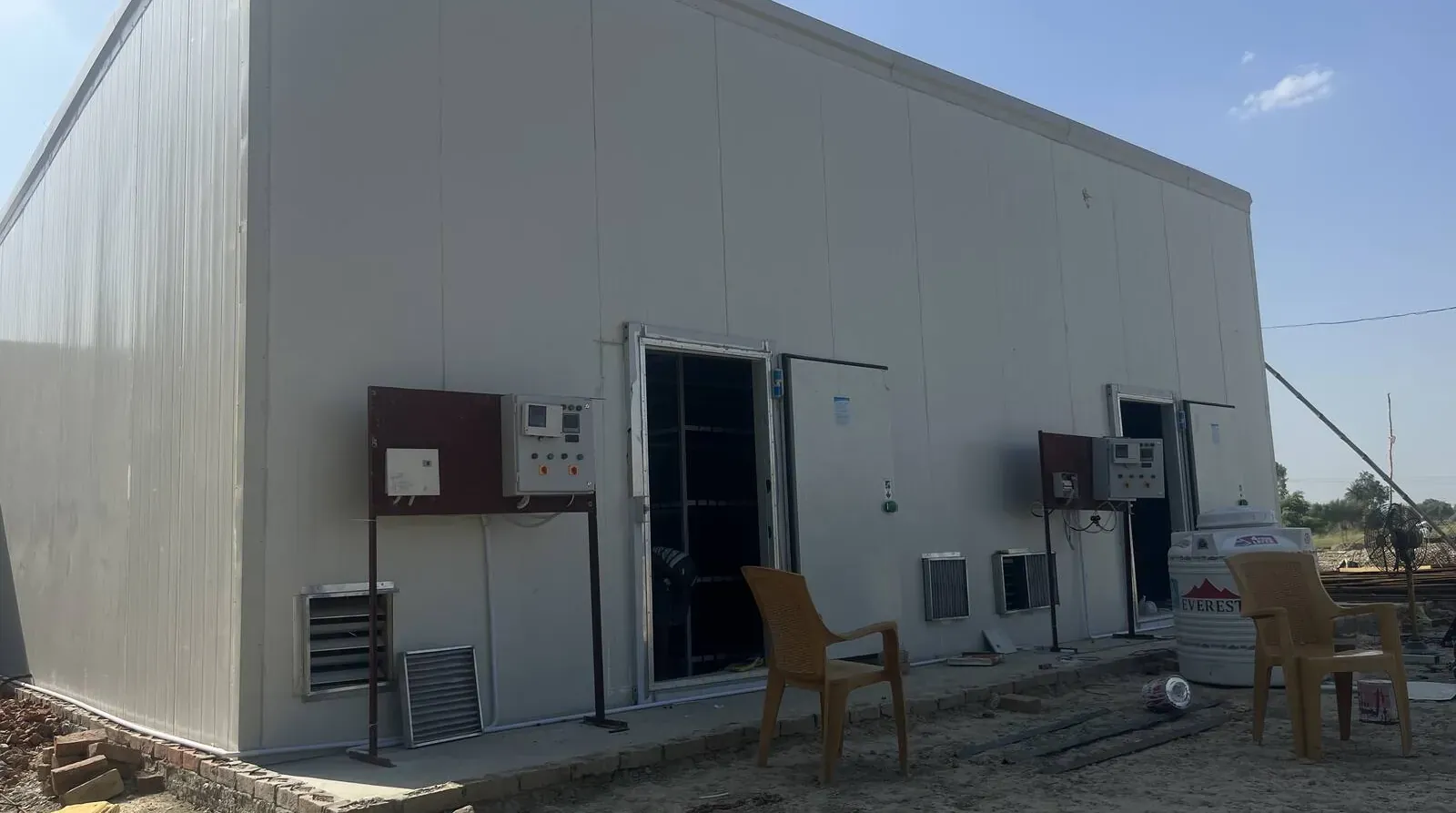
Two national schemes pay for the farm itself, and one project may use one of them, not both. MushroomWale works out which door pays more for the farm you want, files the claim, and builds what the sanction was given for.
- 6government documents, named and dated on this page
- 36states and union territories covered
- 21 Aug 2026the NHB circular these rates are current to
- 12films of farms we have built
Two doors · you may walk through one
40% of fixed cost norms — ₹30L rooms, ₹30L compost, ₹20L spawn
MIDH Operational Guidelines 2025, printed 31 December 2024
35% of ₹75,000 a tonne of capacity — ₹85,000 with canning
NHB Operational Guidelines, January 2025, item 1 (vi) · rate revised 21 Aug 2026
Break ground before NHB issues its Grant of Clearance and the application is rejected outright.
Three rules decide whether you get the money. None of them is about the percentage.
A grower who reads only the rates can still lose the entire claim. These three are what actually sink applications, and the first one is decided by an act that feels like progress — starting work.
Costs you the whole claim
Build before NHB clears the project and the application is rejected outright.
Chapter 04, item 4, verbatim: "Commencement of any project works at site before GOC is not permitted and shall lead to rejection of the application."
- The GoC comes after the bankable DPR and the sanctioned term loan, not before them
- Allowed first, from your own margin money: land levelling, pits, fencing with a gate, a borewell, the power application, internal roads and drainage
- Nothing else. Not a foundation, not a panel, not a rack
- The In-Principle Approval cum Letter of Comfort is no longer compulsory — the GoC is
NHB Operational Guidelines, January 2025 · Chapter 04, item 4 (PDF p.52); stated again on p.50 and in the Important Instructions
Costs you the NHB route
Below 50 MT of capacity this NHB item pays nothing — not less, nothing.
The band reads "above 50 MT and up to 300 MT". "Above", not "at least".
- At 50 MT exactly you are outside the band
- There is no reduced rate underneath it — the item simply does not apply
- MIDH sets no minimum capacity at all, so a smaller farm belongs there
- The ceiling is 300 MT: capacity beyond that adds nothing to the claim
NHB Operational Guidelines, January 2025 · Item 1 (vi), capacity band
Costs your family the scheme
One member of a family, ever — and family now reaches your parents and adult children.
Item 1 of the circular, verbatim: the term "family" shall comprise the applicant’s spouse, father, mother, sons and daughters.
- Once any member has taken NHB assistance, no other member gets anything under any NHB scheme
- "Irrespective of any unutilised portion of the maximum admissible ceiling"
- It applies through an HUF, a partnership or a directorship
- The January 2025 guideline read "husband, wife, dependent minor children" — the circular widened it
NHB Public Circular, 21 August 2026 · Item 1, "Revised Definition of Family and Eligibility" (page 1 of 4)
Three more conditions worth knowing
Five categories cannot apply at all.
Item 2 of the circular bars them outright, whatever the project looks like.
- Present holders of Constitutional Posts
- Ministers, MPs, MLAs, MLCs, Mayors and District Panchayat Chairpersons
- Serving government, PSU, autonomous and local-body employees, except MTS / Class-IV / Group-D
- Retired pensioners drawing ₹10,000 a month or more, same exception
- Groups of Farmers — dropped from NHB's eligible-organisations list
NHB Public Circular, 21 August 2026
The cost of the land is not eligible project cost.
Item 5, verbatim: "The cost of land shall not be considered as part of the eligible project cost under the revised provisions."
- Budget the land separately — no scheme money comes back against it
- The January 2025 guideline had allowed it in some cases; the circular removed that
NHB Public Circular, 21 August 2026
NHB and MIDH are a choice, never a stack.
Mutually exclusive on one project, in NHB's own words.
- The subsidy claim set includes a signed declaration of non-availment from NHM/MIDH
- Choosing wrong is not reversible halfway through a build
- Pick the door that pays more for the farm you are actually building
NHB Operational Guidelines, January 2025
We check all three before a client lays a single brick. It takes one conversation, and it is the cheapest hour on the whole project.
What would the government pay toward your farm?
MIDH pays a share of fixed cost norms. NHB pays a share of a cost worked out from your capacity. They pay different amounts for the same farm, and you may only use one — so this works out both and tells you which one is worth more.
Your project
NHB prices the whole project off this number. MIDH ignores it.
Pick a state and what you are building. You will get:
- What MIDH would pay, and what NHB would pay, for the same farm
- Which of the two is worth more to you, and by how much
- The working behind each figure, with its guideline clause
- What is left for you to fund, since both are paid after the build
MIDH or NHB. That is the whole decision.
Everything else you have been sent — NABARD, RKVY, PMEGP, AIF, Mudra — either helps with the loan or does not apply to a growing unit at all. Both of those are further down. This is the part that pays for the farm.
Two schemes pay for the farm. You may use one of them.
NHB's own guideline makes NHB and MIDH mutually exclusive on a single project, and the claim set includes a signed declaration that you have not taken the other. So the whole of this page comes down to one decision — and it is not reversible halfway through a build.
IfUnder 50 MT a year
MIDH. It is the only door open.
NHB's mushroom item starts above 50 MT and pays nothing below it. MIDH sets no minimum at all, and under ₹30 lakh it does not even insist on a bank loan.
IfAbove 50 MT a year
Usually NHB — but work out both.
NHB prices the project from capacity at ₹75,000 a tonne with no rupee cap, so it overtakes MIDH's ₹32 lakh ceiling quickly. It costs you a compulsory term loan and a clearance you must wait for.
IfA cold room as well
Either — both fund it, separately.
MIDH pays 35% / 50% of ₹9,600–₹12,000 a tonne of cold storage; NHB pays 35% / 45% capped at ₹2 crore. This is a separate claim from the growing unit, not a reason to switch doors.
The calculator above works out both doors for your farm. The two cards below are the full detail, each figure with the document it came from.
MIDH – Mushroom Development Component
Mission for Integrated Development of Horticulture
- 40% of the cost norm in general areas, 50% in NE & Himalayan states, Scheduled Areas and the islands
- Up to ₹32 lakh across growing rooms, compost unit and spawn lab — ₹40 lakh at the enhanced rate
- No minimum capacity. Bank loan optional up to ₹30 lakh
- Also funds a cold room, at 35% / 50% of ₹9,600–₹12,000 a tonne
NHB – National Horticulture Board
Capital Investment Subsidy for Commercial Horticulture
- 35% in general areas, 45% in NE & Himalayan states, Scheduled Areas and the UTs
- Priced at ₹75,000 a tonne of capacity — ₹85,000 with canning — not on what you spend
- Capacity above 50 MT to 300 MT. Below 50 MT it pays nothing at all
- No rupee cap: up to ₹89.25 lakh general, ₹1.1475 crore enhanced
How the claim is actually filed.
Six steps, the documents each one needs, and roughly how long it takes. Tick the checklist as you collect things — or hand the whole thing to us. Only the two schemes that pay for the farm are here; the loan-side schemes are applied for on their own portals, named further down.
MIDH
Mission for Integrated Development of Horticulture
Progress
Step 1 of 6
Step 1: Project Planning & DPR
2-4 weeksPrepare a detailed project report with technical specifications, financial projections, and implementation timeline.
Pro Tips
- Use standard MIDH DPR format from State Horticulture Department
- Include machinery specifications with brand names and model numbers
- Financial projections should cover 5 years minimum
Document Checklist
0/5Get DPR from authorized consultant or MushroomWale
Or hand the whole file to us — DPR, bank, department, clearance, build, claim.
These help with the loan, not with the farm.
None of these is an alternative to MIDH or NHB. They make the borrowing cheaper, easier or possible at all, and they sit alongside whichever door you take. Worth knowing about, not worth agonising over.
- AIFCredit3% interest subvention on up to ₹2 crore of loan for 7 years — roughly ₹42 lakh of interest relief across the term. It caps the LOAN, not a subsidy, and pays nothing toward the build.Cold storage, pack houses, spawn labs and processing financed on a term loan · agriinfra.dac.gov.in
- CGTMSECreditA credit guarantee, so the bank can lend without taking your property as collateral. A guarantee fee applies.Anyone whose loan is stuck on collateral
- MudraCreditA collateral-free loan up to ₹10 lakh. No subsidy component at all.A small unit that needs working capital quickly · udyamimitra.in
- Stand-Up IndiaCreditA composite bank loan for SC/ST and women entrepreneurs. A loan, not a grant.First-time SC/ST or women promoters who need the bank to say yes · standupmitra.in
- PMEGPGrantMargin-money subsidy of 15-35% depending on category and location, on projects up to ₹50 lakh.Compost units, spawn labs and processing — manufacturing, not a cultivation shed · kviconline.gov.in/pmegpeportal
- SMAMGrantHorticultural machinery up to ₹5.8 lakh. Crop-agnostic — it funds the machine, whatever you grow.Equipment lines inside a larger project
What cannot be stacked: not MIDH and NHB on the same project, and never the same component twice from two schemes. What can: a different scheme for a genuinely different component — your growing rooms under one door, an AIF-subvented loan behind the cold store, a CGTMSE guarantee over the whole borrowing. Your state horticulture department has the final word on the combination.
These are not what you were told they are.
All three come up in conversations about mushroom subsidy, and none of them pays for a growing unit — including the claim this page itself used to make about NABARD.
NABARD
A 25–40% mushroom subsidy
Refinance to your bank. It pays nothing toward the farm.
- Every mushroom figure in its 31 state unit-cost booklets is a LENDING unit cost
- Printed beside columns headed "Bank Loan Factor (%)" and "Repayment Period (Years)"
- Its own model mushroom project funds the whole cost as 10% margin money plus a 90% bank loan at 10–12.5%
If someone quotes you a NABARD subsidy percentage, ask which document and which page it is printed on.
NABARD unit-cost booklets, all 31 states
PM-RKVY
40–50%, or “varies by state”
No published mushroom rate at all.
- Mushroom appears once in 354 pages of the PM-RKVY Operational Guidelines 2024
- In the intervention list of Rainfed Area Development — and in no cost-norm table anywhere
- A state may still write a mushroom item into its own Annual Action Plan
Ask your State Agriculture Department whether this year's plan carries a mushroom item.
PM-RKVY Operational Guidelines 2024
PMFME
35% toward a mushroom farm
35% toward processing. Never the growing rooms.
- Credit-linked capital subsidy, 35%, maximum ₹10 lakh for an individual micro unit
- Covers drying, pickling, powder, IQF, packaging and branding
- A cultivation shed is not an eligible activity under it
Worth having later. It is not the scheme that pays for your farm.
PMFME scheme guidelines, Ministry of Food Processing Industries
What your state adds on top.
The central rates are the same everywhere. What changes is your state's Annual Action Plan, its portal, its own kit and top-up programmes, and whether it has budget left this year.
Select a state to view detailed subsidy information including eligibility, documentation, and application process
For latest district-level approvals, our team verifies directly with the concerned horticulture office.
Straight answers, with the clause behind each one.
If an answer here contradicts something you have been told, the document named in it is the one to check.
Every figure here is bound to a government clause we have read end to end.
Not summarised from a blog, not carried over from last year's guideline. Where a number could not be traced to a primary document, it was taken off this page rather than softened — which is why some schemes above carry no percentage at all.
- 44schemes, central and state, each bound to its own clause
- 36states and union territories, every one read
- 30+archived documents, each stored under its SHA-256
- 0figures published without the document they came from
The six documents behind this page
- MIDH Operational Guidelines 2025 (Mission for Integrated Development of Horticulture)
Department of Agriculture & Farmers Welfare, Government of India · dated 31 December 2024 · read 14 Sept 2026
- Operational Guidelines, National Horticulture Board (96 pages), effective 1 January 2025
National Horticulture Board, Ministry of Agriculture & Farmers Welfare · dated January 2025 · read 14 Sept 2026
- Public Circular No. NHB/CC/Guidelines/2026-27 — revised rates, revised definition of family, and categories not eligible
National Horticulture Board (signed C.P. Gandhi, Joint Director, Coordination) · dated 21 August 2026 · read 14 Sept 2026
- PM-RKVY Operational Guidelines 2024 (Pradhan Mantri Rashtriya Krishi Vikas Yojana), 354 pages
Department of Agriculture & Farmers Welfare, Government of India · dated 2024, applicable from financial year 2024-25 · read 14 Sept 2026
- NABARD state-wise Unit Cost booklets and the NABARD Model Bankable Project for mushroom cultivation
National Bank for Agriculture and Rural Development · dated Current editions; all 31 state booklets read · read 14 Sept 2026
- Agriculture Infrastructure Fund — Operational Guidelines (Central Sector Scheme)
Department of Agriculture & Farmers Welfare, Government of India · dated As amended to 2025-26 · read 14 Sept 2026
Each document is archived in the atlas under its SHA-256, so a silently replaced file fails our build rather than our readers.
Tell us about the farm. We will tell you what it qualifies for.
- Which of the two doors pays more for your project
- Whether anything in your situation bars the NHB route
- What your state's plan carries this year
- A call back within one working day
Apply for a mushroom farming subsidy
Share your details, the scheme you want to apply under and your documents. Our subsidy desk checks eligibility, tells you what is missing and prepares the project report the department asks for.
We do not advise on the subsidy. We get it, and we build the farm.
One company, one file, one accountable party — from working out which door pays more to the joint inspection that releases the money.
- Work out which door pays moreMIDH or NHB, priced against the farm you actually want
- Write the bankable DPROn the scheme's own template, with capacity stated the way it asks
- Take it through the bank and the departmentSanction, then Grant of Clearance — in that order, never the other way
- Build what the sanction was given forSo the joint inspection matches the approved DPR line for line
- File the claim after completionBoth schemes are back-ended; the money lands in the loan account
Disclaimer: MushroomWale is a private consulting and project execution company.
Subsidy schemes are governed by Central and State Governments and may change without notice.
Approval, amount, and timelines depend on government authorities, banks, and applicant eligibility.
MushroomWale does not guarantee subsidy approval.