
Mushroom Pest & Disease Guide — India (2026)
Identify and control the six diseases and four pests that do the most damage on Indian button mushroom farms. Built around sanitation, Phase-2 discipline, and the 70°C cook-out — not chemicals.
What are the most common mushroom diseases in India?
Six recurring problems dominate Indian button mushroom farms: dry bubble (Verticillium), wet bubble (Mycogone), cobweb (Cladobotryum), green mould (Trichoderma aggressivum), bacterial blotch (Pseudomonas tolaasii), and Virus X / La France. Green mould and dry bubble cause the largest losses, almost always traceable to under-pasteurised Phase-2 compost or sciarid-fly carriage. The fix is tighter Phase-2 discipline, casing pasteurisation, insect screening, and a 70°C post-cycle cook-out — fungicides are a last resort.
Six Major Diseases
Dry Bubble (Verticillium fungicola)
Symptom: Distorted, browned caps; tilted stipes; 'onion-shaped' fruit bodies
Cause: Airborne spores; carried in by flies and dirty tools
Control: Strict sanitation, formaldehyde post-cropping clean-out, casing pasteurisation, BAS-recommended fungicide rotation only
Wet Bubble (Mycogone perniciosa)
Symptom: White cottony mass replacing fruit body; foul odour; brown leakage
Cause: Contaminated casing soil; soil-splash during watering
Control: Steam-pasteurise casing @ 65°C/4 hr, dry pin-head zone, remove infected patches with salt sealing
Cobweb (Cladobotryum dendroides)
Symptom: Fast-spreading white-grey mycelial web on casing and pinheads
Cause: High humidity + low ventilation; wet casing surface
Control: Drop RH to 80%, increase air-change, salt-cover spots, clean casing tools between rooms
Green Mould (Trichoderma aggressivum)
Symptom: Bright green patches on compost; pinning failure
Cause: Under-pasteurised compost; cross-contamination from spawn
Control: Phase-2 pasteurisation @ 58°C/8 hr properly held, sanitise spawning equipment, source clean spawn
Bacterial Blotch (Pseudomonas tolaasii)
Symptom: Yellow-brown sunken spots on cap; slimy surface
Cause: Free water sitting on caps + warm temperature
Control: Dry caps within 4 hr of watering, RH 85% (not 95%), chlorinated water for irrigation (150 ppm)
Virus X / La France
Symptom: Mis-shapen pins, low yield, premature opening, drumstick stems
Cause: Spore + mycelium transmission via tools, flies, infected spawn
Control: Source virus-tested spawn, disinfect tools between rooms, deep clean-out + formaldehyde fumigation post-cycle
Pests That Carry Disease
Sciarid Flies (Lycoriella)
Damage: Larvae tunnel through compost and pins; vector for Verticillium and mites
Control: Insect-screen 32-mesh on intakes, yellow sticky traps, BTI larvicide in compost, neem-cake on casing
Phorid Flies (Megaselia)
Damage: Larvae feed on mycelium and developing pins; harder to control than sciarids
Control: Tight room sealing, post-cycle cook-out @ 70°C/12 hr, sticky traps, sanitation around drains
Mushroom Mites (Tarsonemus, Pygmephorus)
Damage: Feed on mycelium; carry green mould and bacterial spores
Control: Pre-cropping cook-out, casing sterilisation, end-of-cycle steam-off room before opening
Nematodes (Aphelenchoides)
Damage: Patchy yield drop, shrunken pins, brown compost zones
Control: Phase-1 turning + Phase-2 pasteurisation kill nematodes; control stops at hygiene
Eight-Point Sanitation SOP
This is general best-practice guidance. Always confirm pasteurisation temperatures and any chemical use with your state agriculture / horticulture department and DMR Solan extension advisories.
Frequently Asked Questions
Why Choose MushroomWale
- 01
Engineering Expertise
Agrimotion Engineering Private Limited is a registered EPC company (CIN U43900UP2023PTC185328, GSTIN 09AAZCA0158R1ZP) based in Firozabad, Uttar Pradesh.
- 02
Proven Track Record
Turnkey mushroom projects from a 2-room starter to a 20-room commercial farm.
- 03
Bank-Recognized DPRs
Bank-format DPRs prepared to NABARD, NHB and MIDH norms for loan and subsidy applications.
Stop losing yield to preventable disease
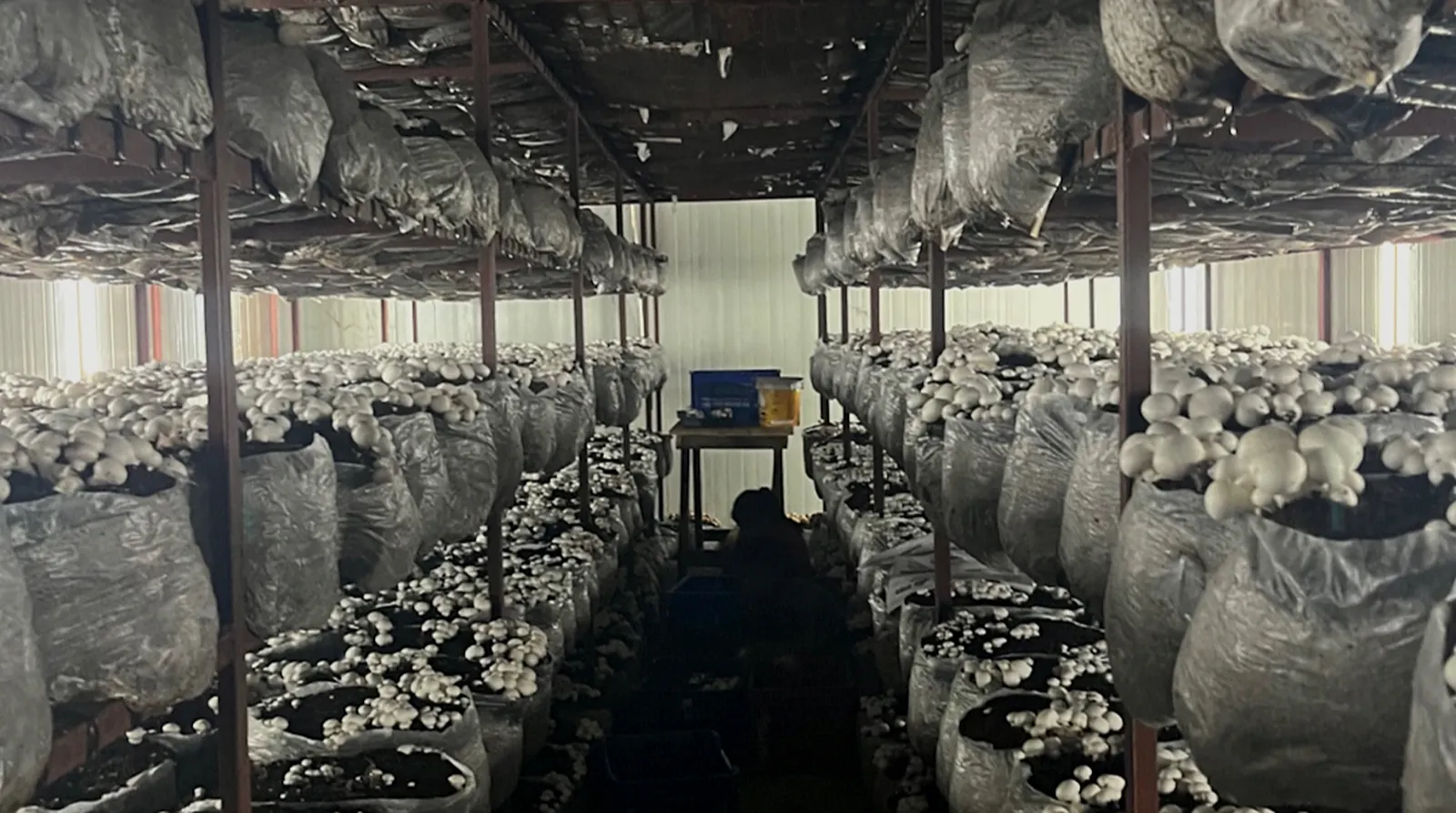
MushroomWale designs farms with airlocks, screened intakes, and cook-out-ready rooms — and trains your team on the 8-point sanitation SOP that keeps cycle-5 yield as strong as cycle-1.
- Turnkey farms built
- Pan-India delivery
- Bank-ready DPR