
Mushroom Farming Subsidy in India
A private applicant gets 40% of the cost norm in a general area and 50% in NE and Himalayan states, as a credit-linked back-ended subsidy. Every figure below is cited to the guideline it comes from.
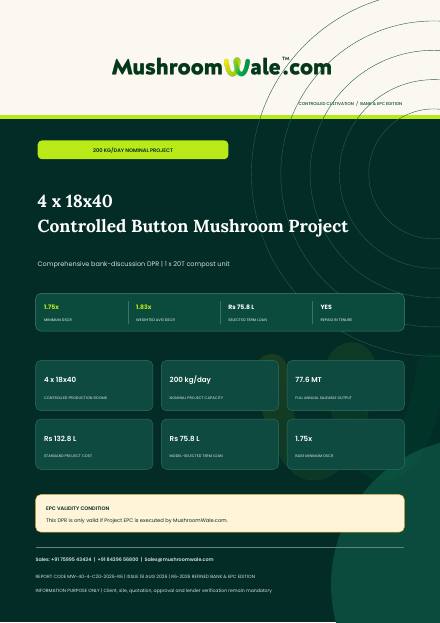
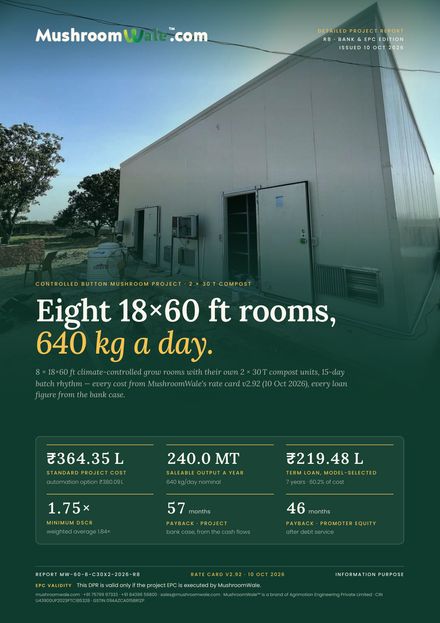
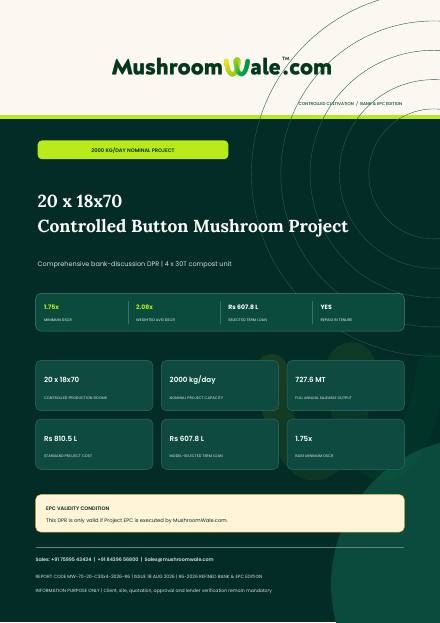
How much subsidy can a mushroom farm get in India?
Two national schemes pay toward a commercial mushroom farm in India, and one project may use one of them, not both. Under the MIDH Operational Guidelines 2025 (printed 31 December 2024) a private applicant in a general area receives 40% of fixed cost norms: up to Rs 12 lakh on a mushroom production unit (Rs 30 lakh norm), Rs 12 lakh on a compost making unit and Rs 8 lakh on a spawn unit, rising to 50% in North-Eastern and Himalayan states, Scheduled Areas, Andaman & Nicobar and Lakshadweep. Under the NHB Operational Guidelines of January 2025, as amended by NHB Public Circular No. NHB/CC/Guidelines/2026-27 dated 21 August 2026, an integrated mushroom unit is priced at Rs 75,000 per tonne of installed capacity without canning and Rs 85,000 per tonne with canning, for capacity above 50 MT and up to 300 MT, at 35% in general areas and 45% in North-Eastern and Himalayan states, Scheduled Areas and the Union Territories of Andaman & Nicobar, Lakshadweep, Jammu & Kashmir and Ladakh — a maximum of Rs 89.25 lakh and Rs 1.1475 crore respectively. Starting construction before NHB issues its Grant of Clearance leads to rejection of the application. NABARD pays no mushroom subsidy: its published mushroom figures are unit costs that banks lend against. PM-RKVY publishes no mushroom rate.
Scheme Updates, 2024–2026
From PIB, MIDH, NHB and official portals, newest first. For current rates and ceilings see the subsidy page, where every figure is cited to its clause.
NHB Public Circular — rate cut to 35% / 45%
NHB's Public Circular No. NHB/CC/Guidelines/2026-27 cut the back-ended subsidy from 40%/50% to 35%/45%, revised the definition of family and listed categories that are not eligible. Older NHB guides quoting 40%/50% are superseded. NHB and MIDH are a choice, never a stack — the current rules for each scheme are on our subsidy page, clause by clause.
MIDH Operational Guidelines Revised (first time since 2014)
Ministry of Agriculture released new MIDH guidelines (DO No. M-14011/5/2024-MIDH dated 31 Dec 2024). Cost norms for mushroom production units revised upward to reflect 2024 input prices. Funding ratio unchanged: GOI 60% (general) / 90% (NE & Himalayan).
AIF — interest relief on the loan, not a grant
3% interest subvention on up to ₹2 crore of loan for 7 years — roughly ₹42 lakh of interest relief across the term. It caps the LOAN, not a subsidy, and pays nothing toward the build. Best for: cold storage, pack houses, spawn labs and processing financed on a term loan.
PMFME — Extension Sought Beyond 2025-26
As of June 2025: ₹3,791 Cr released, 1,44,517 loans worth ₹11,501 Cr sanctioned. MoFPI has sought continuation with revised norms (pending Cabinet approval). 35% credit-linked subsidy (max ₹10 L) for mushroom drying, pickling, powder & packaging units continues.
Tamil Nadu — Mushroom Declared an Agricultural Activity
TN Agriculture Dept officially reclassified mushroom cultivation as agriculture. Unlocks Kisan Credit Card, PMFBY crop insurance, and full NHM/MIDH benefits — including for landless cultivators.
Quick Eligibility Checker
Answer 8 quick questions — get a ranked list of best-fitting subsidies with subsidy %, why-it-fits, and next steps.
DPR Document Checklist Generator
Pick your scheme and project type — download a ready-to-print PDF checklist with every document, annexure and technical sheet your DPR needs.
23 items will be included
14 common DPR items + 3 MIDH-specific + 6 technical annexures for Production Unit (Grow Rooms).
How the claim is actually filed.
Six steps, the documents each one needs, and roughly how long it takes. Tick the checklist as you collect things — or hand the whole thing to us. Only the two schemes that pay for the farm are here; the loan-side schemes are applied for on their own portals, named further down.
MIDH
Mission for Integrated Development of Horticulture
Progress
Step 1 of 6
Step 1: Project Planning & DPR
2-4 weeksPrepare a detailed project report with technical specifications, financial projections, and implementation timeline.
Pro Tips
- Use standard MIDH DPR format from State Horticulture Department
- Include machinery specifications with brand names and model numbers
- Financial projections should cover 5 years minimum
Document Checklist
0/5Get DPR from authorized consultant or MushroomWale
Or hand the whole file to us — DPR, bank, department, clearance, build, claim.
What each part of the project can claim
Rates and cost norms below are quoted from the MIDH Operational Guidelines 2025 (dated 31 December 2024). A commercial project usually claims on the growing rooms and the compost unit, so the two add up.
| Component | Cost norm | General areas | NE & Himalayan, scheduled areas |
|---|---|---|---|
| Mushroom production unitThe growing rooms themselves | ₹30 lakh cost norm | 40% — up to ₹12 lakh | 50% — up to ₹15 lakh |
| Compost making unitPhase-I bunkers and Phase-II tunnels | ₹30 lakh cost norm | 40% — up to ₹12 lakh | 50% — up to ₹15 lakh |
| Spawn making unitThe spawn laboratory | ₹20 lakh cost norm | 40% — up to ₹8 lakh | 50% — up to ₹10 lakh |
Credit-linked and back-ended: the subsidy is released to your bank after the unit is built and inspected, against a sanctioned term loan. Public-sector applicants are assisted at 100% of the cost norm under the same clause.
Whole-project route: NHB — Integrated Mushroom Production Unit, project mode
A commercial mushroom project can also be taken to the National Horticulture Board as one project. The guideline reads: “in controlled conditions @ Rs. 75000/MT without canning and @ Rs. 85000/MT with Canning including Production Unit + Compost Making Unit” (Item 1 (vi); rate as revised by the Public Circular of 21 August 2026).
Credit schemes that are often confused with subsidy
NABARD refinance
Refinance to your bank, not a grant. The subsidy above is routed through the same term loan.
PMEGP
Margin-money subsidy for a first-generation entrepreneur, applied for through KVIC, not horticulture.
Stand-Up India
Loan window for SC/ST and women entrepreneurs. A loan, not a subsidy.
Sources
- MIDH Operational Guidelines 2025 (Mission for Integrated Development of Horticulture)Department of Agriculture & Farmers Welfare, Government of India · document dated 31 December 2024 · read on 14 September 2026
- Operational Guidelines, National Horticulture Board (96 pages), effective 1 January 2025National Horticulture Board, Ministry of Agriculture & Farmers Welfare · document dated January 2025 · read on 14 September 2026
- Public Circular No. NHB/CC/Guidelines/2026-27 — revised rates, revised definition of family, and categories not eligibleNational Horticulture Board (signed C.P. Gandhi, Joint Director, Coordination) · document dated 21 August 2026 · read on 14 September 2026
- PM-RKVY Operational Guidelines 2024 (Pradhan Mantri Rashtriya Krishi Vikas Yojana), 354 pagesDepartment of Agriculture & Farmers Welfare, Government of India · document dated 2024, applicable from financial year 2024-25 · read on 14 September 2026
- NABARD state-wise Unit Cost booklets and the NABARD Model Bankable Project for mushroom cultivationNational Bank for Agriculture and Rural Development · document dated Current editions; all 31 state booklets read · read on 14 September 2026
- Agriculture Infrastructure Fund — Operational Guidelines (Central Sector Scheme)Department of Agriculture & Farmers Welfare, Government of India · document dated As amended to 2025-26 · read on 14 September 2026
State horticulture departments run their own top-ups with their own ceilings; ask your district horticulture officer for the current state order before you budget.
6-Step Application Process
Register as farmer/entrepreneur on state horticulture portal
Prepare Detailed Project Report (DPR) with financials
Submit application with land documents & Aadhaar
District horticulture officer conducts site inspection
Approval from state/central committee (30-90 days)
Release of subsidy directly to bank account (post-construction)
Related Financing & Resource Guides
NABARD Mushroom Loan
Bank loan process with NABARD refinancing
PMEGP for Mushroom
15-35% margin money for new entrepreneurs
DPR for Bank Loan
How to prepare a bankable DPR
Subsidy Blog Guide
State-wise subsidy breakdown
Business Plan Template
Complete DPR with financials
Turnkey Farm Setup
End-to-end project delivery
Frequently Asked Questions
Official Scheme Document
NHB and MIDH mushroom subsidy — current rules
Eligibility, rates and ceilings for each scheme, cited clause by clause from the current documents. NHB and MIDH are a choice, never a stack.
Why Choose MushroomWale
- 01
Engineering Expertise
Agrimotion Engineering Private Limited is a registered EPC company (CIN U43900UP2023PTC185328, GSTIN 09AAZCA0158R1ZP) based in Firozabad, Uttar Pradesh.
- 02
Proven Track Record
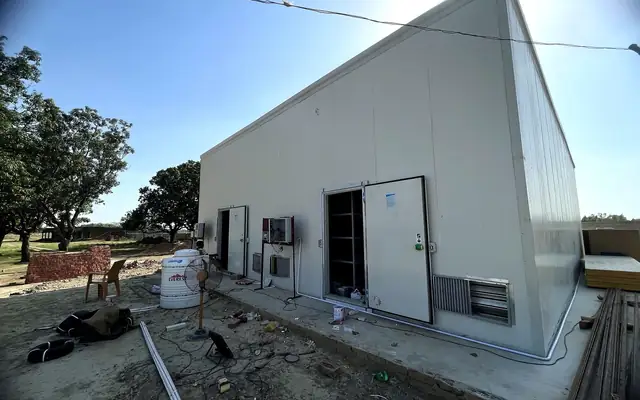
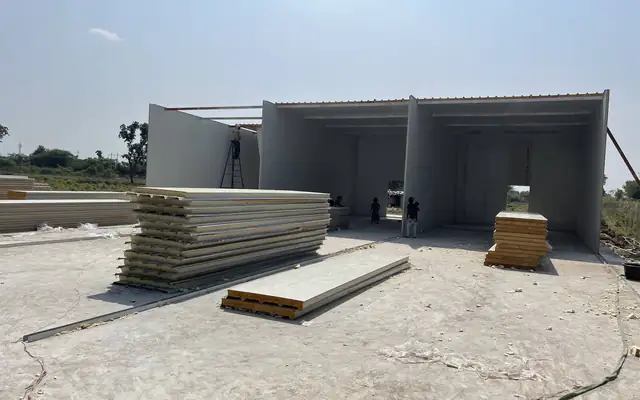
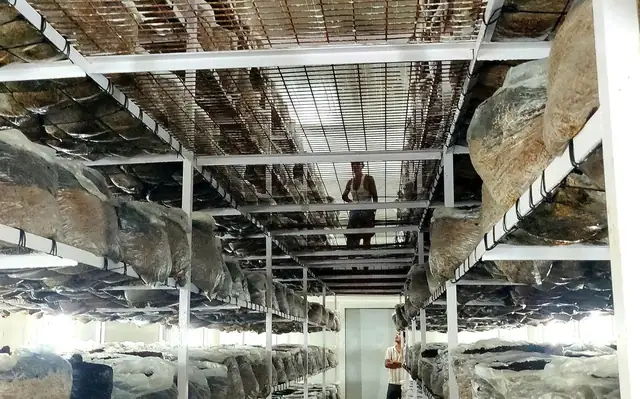
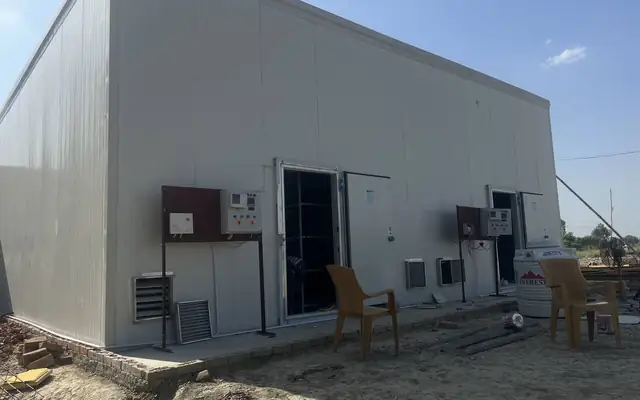
Turnkey mushroom projects from a 2-room starter to a 20-room commercial farm.
- 03
Bank-Recognized DPRs
Bank-format DPRs prepared to NABARD, NHB and MIDH norms for loan and subsidy applications.
Get a Free Quote & DPR for Your Mushroom Farming Subsidy
Share your requirement and our engineers send a tailored quotation, BOQ and subsidy-ready DPR — straight to your WhatsApp within 24 hours.
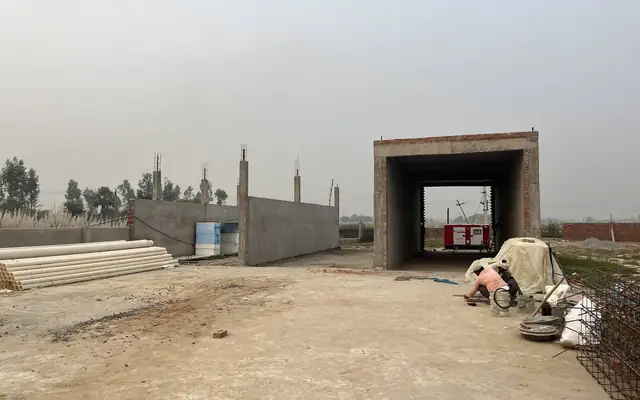
Need Help With Your Subsidy Application?
MushroomWale provides free DPR preparation assistance for all turnkey project clients.
- Turnkey farms built
- Pan-India delivery
- Bank-ready DPR