
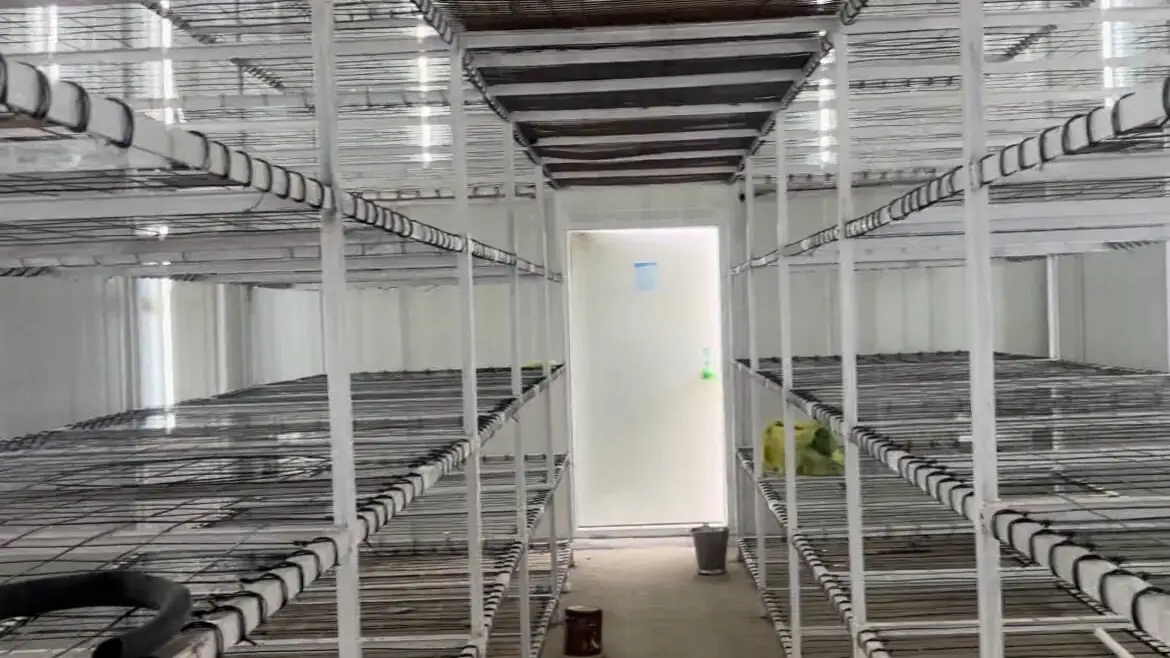
Hygiene, Pest and Disease SOP — Prevention, Detection and Response — India Setup Procedure & Equipment Cost
Mushroom farm hygiene and disease SOP — biosecurity zoning, disinfection, fly control, green mould and bubble response, 65–70 °C cook-out, cost and PDF.
Operations SOP — in short
Mushroom farm hygiene is a prevention system, not a spraying schedule. It is built on four controls: a sealed envelope with insect screens on all fresh-air intakes, a one-way clean-to-dirty movement flow with footwear change and foot dips at every room, pasteurised compost and casing, and a cook-out at 65–70 °C for 8–12 hours after any diseased crop. Diseases are managed by immediate localised salting of patches, never by disturbing them, because Trichoderma, Verticillium and Mycogone all spread as airborne spores.
Why this procedure matters
Every serious disease outbreak on a mushroom farm can be traced to a break in one of four barriers: the compost, the casing, the air, or the people. Chemicals are the last line, not the first, and a farm that relies on fungicides is already losing. The economics are brutal — a single Trichoderma outbreak across a room can remove an entire cycle's margin, and the spores stay in the building until a cook-out removes them.
This SOP is written as a prevention system with a documented response path. It defines biosecurity zoning, the disinfection schedule, the fly and mite control regime, the specific response for each of the major diseases seen on Indian farms, and the cook-out protocol that resets a contaminated room.
Discipline beats sophistication here. A farm with a strict footwear rule, screened intakes and pasteurised casing will out-perform a farm with expensive filtration and casual staff movement, every single cycle.
Step-by-step procedure
1. Zone the farm clean to dirty
Define zones: compost yard and spent-compost area are dirty; spawning and casing areas are clean; grow rooms are clean; packing hall is clean. Movement is always clean to dirty within a shift and never the reverse. Physically separate the spent-compost disposal route from the fresh-compost intake route — if the same tractor travels both, the farm has no biosecurity regardless of what else it does.
- Documented zone map displayed on site
- Separate routes for fresh and spent compost
2. Personnel protocol
Dedicated farm footwear and clothing that never leave the site. Foot dip with fresh disinfectant at every room door, changed daily. Hand wash and sanitiser before entering any room. Restrict visitor access completely during spawn run and case run. Any worker who has been in a contaminated room does not enter a clean room for the rest of that shift.
- Foot dips refreshed daily
- No visitor access during spawn run and case run
3. Physical exclusion of insects
Insect-screen every fresh-air intake with a mesh fine enough to exclude sciarid and phorid flies, and inspect the screens weekly for tears. Keep drain traps water-filled, seal all cable and pipe penetrations, and fit door sweeps. Place UV light traps inside corridors and record catch counts weekly — a rising count is an early warning that the exclusion has failed somewhere.
- All intakes screened
- Weekly screen inspection
- Weekly UV trap counts logged
4. Sanitation schedule
Daily: sweep and disinfect corridors, remove all mushroom waste and stumps from the farm, refresh foot dips. Weekly: wash the packing hall, clean AHU filters, disinfect harvest crates and knives. Per cycle: full wash-down and disinfection of the emptied room, racks, floors and drains before refilling. Never store spent compost adjacent to grow rooms.
- Zero mushroom waste left on site overnight
- Full room disinfection between every cycle
5. Detection — the daily inspection round
Torch-inspect every bed daily and record any abnormality by room, tier and position. Train pickers to report abnormal mushrooms rather than pick and discard them silently, because pickers see the crop far more closely than supervisors do. Photograph everything abnormal — the photograph record is what makes pattern recognition possible across cycles.
- Daily documented inspection of every room
- Photograph and log every abnormality
6. Disease-specific response
Green mould (Trichoderma): cover the patch with salt immediately, do not brush or disturb; review pasteurisation. Dry bubble (Verticillium): distorted, greyish, split caps — salt the patch, stop watering the area, and check casing pasteurisation and fly control, since flies are the main vector. Wet bubble (Mycogone): white deformed masses — salt heavily, isolate, and treat casing hygiene as the root cause. Cobweb (Cladobotryum): grey fuzzy growth spreading fast — cover with salt or paper towel soaked in disinfectant, never fan it. Bacterial blotch (Pseudomonas): brown sticky lesions — reduce RH, increase air movement so cap surfaces dry between waterings.
- Response within the same shift
- Patches covered, never brushed
- Root cause recorded against the responsible SOP
7. Fly and mite management
Exclusion first, then monitoring, then treatment. Keep the site free of decaying organic matter, dispose of spent compost away from rooms, and maintain UV traps. Where chemical intervention is unavoidable, use only products approved for mushroom crops, observe the pre-harvest interval strictly, and record the application. A farm supplying organised retail will be audited on exactly this record.
- UV trap counts trending down
- Every chemical application recorded with PHI observed
8. Cook-out and room reset
After any crop with a disease incident, and as good practice at the end of every cycle where steam is available, cook out the sealed room at 65–70 °C for 8–12 hours before emptying. This kills pathogens and pests in the compost, casing, racks and room surfaces before the material is disturbed and spores go airborne. Only then empty, wash and disinfect.
- 65–70 °C for 8–12 hours
- Cook out before emptying, never after
Operating parameters
| Parameter | Target | Tolerance | Note |
|---|---|---|---|
| Cook-out temperature | 65–70 °C | 8–12 hours | Before emptying the room |
| Casing pasteurisation | 65–70 °C | 6–8 hours | Primary defence against Verticillium and nematodes |
| Compost pasteurisation | 58–60 °C | 6–8 hours | Primary defence against Trichoderma and weed moulds |
| Foot dip disinfectant | Fresh daily | per manufacturer dilution | A dirty foot dip is worse than none |
| Cropping RH ceiling | under 92% | 85–90% preferred | Above this, bacterial blotch risk rises sharply |
| UV trap monitoring | Weekly count | trend, not absolute | A rising trend means exclusion has failed |
| Waste removal | Daily | no overnight storage | Stumps and trim are a fly breeding substrate |
Daily and per-cycle routine
- Refresh every foot dip at the start of the first shift and record it.
- Torch-inspect every bed daily; photograph and log any abnormality by room, tier and position.
- Remove all mushroom waste and stumps from the site before the end of each day.
- Count and record UV trap catches weekly per room and corridor.
- Inspect insect screens, door sweeps and drain traps weekly.
- Disinfect harvest crates, knives and trolleys at the end of every picking shift.
- Record every chemical application: product, dose, area, operator, date and pre-harvest interval.
- Hold a monthly review of disease incidents against the compost, casing and climate records to find the actual root cause.
Cost breakdown
What this workstream costs, how each item is measured, and where it sits in the overall project budget.
| Item | Costing basis | Cost band | Note |
|---|---|---|---|
| Insect screening on all intakes | Per intake | Capital, low — highest return of any hygiene spend | Replaced when torn; inspect weekly |
| Disinfectants and foot-dip chemicals | Per month | Recurring, low | Formalin or quaternary ammonium compounds |
| UV light traps | Per unit | Capital, low | One per corridor plus one per packing area minimum |
| PPE — footwear, gloves, masks, aprons | Per worker per year | Recurring, low | Dedicated farm-only sets |
| Cook-out steam | Per room per cycle | Recurring | Requires a steam source; shares the Phase-2 boiler on integrated farms |
| Approved crop-protection chemicals | As needed | Recurring, variable | Only mushroom-approved products; observe pre-harvest intervals |
| Spent compost disposal / handling | Per tonne | Recurring | Can be sold as soil conditioner and become a small revenue line |
| Sanitation labour | Per room per cycle | Recurring | Budget it as a fixed role, not as spare time from picking staff |
Approx. planning guidance only. Live rates follow the current MushroomWale master rate version; quotations carry 5-day validity and a 5% market volatility clause.
GST @ 18% and Transportation are Extra
Civil works, boundary wall, site levelling, land and power sanction are Client Scope. Any additional work demanded beyond the agreed BOQ is treated as extra and charged separately.
Troubleshooting
| Problem | Likely cause | Corrective action |
|---|---|---|
| Green mould recurring cycle after cycle | Under-pasteurised compost or residual spore load in the building | Audit the Phase-2 temperature chart for cold pockets, and cook out every room at 65–70 °C for two consecutive cycles before refilling. |
| Fly population rising despite spraying | Breeding site on site, or a failed exclusion barrier | Find and remove the breeding substrate — usually spent compost, waste stumps or a dry drain trap. Spraying without removing the substrate never works. |
| Dry bubble appearing in a single room only | Casing batch not pasteurised properly, or fly vector localised to that room | Trace the casing batch number, salt the patches, and check that room's intake screen and door seal. |
| Bacterial blotch after every watering | Cap surfaces staying wet too long | Reduce RH to 85–88% and increase air movement so caps dry within 30–60 minutes of watering. |
| Contamination spreading after staff clean a patch | Patch was brushed or scraped, releasing spores | Retrain: patches are covered with salt and left in place. Never brush, never vacuum, never scrape. |
Records to maintain
How this SOP fits mushroom farming setup in India
Mushroom farming setup in India splits into two halves — what you build, and what you run. The build is the insulated grow room, 7-tier racking, refrigeration, fresh-air handling, power and the packhouse. The run is exactly the set of SOPs in this library. The two are locked together: the setpoints in these procedures decide the machine capacity you must buy, and the bed area decides compost tonnage, spawn quantity and achievable yield.
That is why mushroom farming equipment cost can only be estimated once room size, room count, bed area and the site's peak summer temperature are fixed. Any single "cost per room" number quoted without those inputs is misleading — an 18×30 ft room and an 18×60 ft room differ in panel area, racking metres and machine tonnage, and the same room in a hotter district needs a larger machine to hold 16–18 °C during cropping.
The table below shows how each head is measured, so you can sanity-check any quotation you receive. Live rates follow the current MushroomWale master rate version, quotations carry 5-day validity, and GST @ 18% plus transportation are extra.
| Cost head | Measured on | What drives it |
|---|---|---|
| Insulated grow room shell (PUF panels, doors, structure) | Per sq ft of built-up room area | The single largest civil-adjacent head; wall panels 60 mm, roof panels 80 mm, PPGL coated |
| 7-tier MS racking system | Per sq m of bed area | Defines bed area, and therefore compost tonnage, spawn quantity and yield |
| Refrigeration and air handling | Per room, sized on peak summer load | Sized on the location's peak temperature and crop heat load, never on the annual average |
| Fresh air, ducting and controls | Per room | Air cloth duct, mixing chamber, dampers, sensors and the stage-wise controller profile |
| Compost unit (wetting slab and Phase-1 bunkers + Phase-2 tunnel) | Per tonne of batch capacity | Only for integrated farms; grower-only farms buy Phase-2 or Phase-3 compost instead |
| Power infrastructure and DG backup | Per kVA | Sized with starting surge and diversity factor across rooms |
| Packhouse and cold room | Per sq ft + per TR | Pre-cooling to 2–4 °C within 30 minutes is what protects 5–7 day shelf life |
Equipment catalogue
Buy every item used in this SOP
One page with the image, working specification, HSN code, minimum order quantity and live price for each SKU — with a direct buy button. GST and transportation extra.
Download this SOP as a printable PDF
Full procedure, parameter table, cost breakdown, troubleshooting and record sheet — formatted for the farm noticeboard. No form required.
Applying this SOP on your own farm?
Send your details and our project engineer will review your SOP fit, share an itemised cost sheet for your farm size and answer questions on WhatsApp — free.
SOP read: Hygiene, Pest and Disease SOP — Prevention, Detection and Response (Operations)
Frequently asked questions
Other SOPs in this library
Continue the guide series
Why Choose MushroomWale
- 01
Engineering Expertise
Agrimotion Engineering Private Limited is a registered EPC company (CIN U43900UP2023PTC185328, GSTIN 09AAZCA0158R1ZP) based in Firozabad, Uttar Pradesh.
- 02
Proven Track Record
Turnkey mushroom projects from a 2-room starter to a 20-room commercial farm.
- 03
Bank-Recognized DPRs
Bank-format DPRs prepared to NABARD, NHB and MIDH norms for loan and subsidy applications.
Ready to Build Your Mushroom Farm?
Get a free site survey and a custom quote within 24 hours.
- Turnkey farms built
- Pan-India delivery
- Bank-ready DPR