
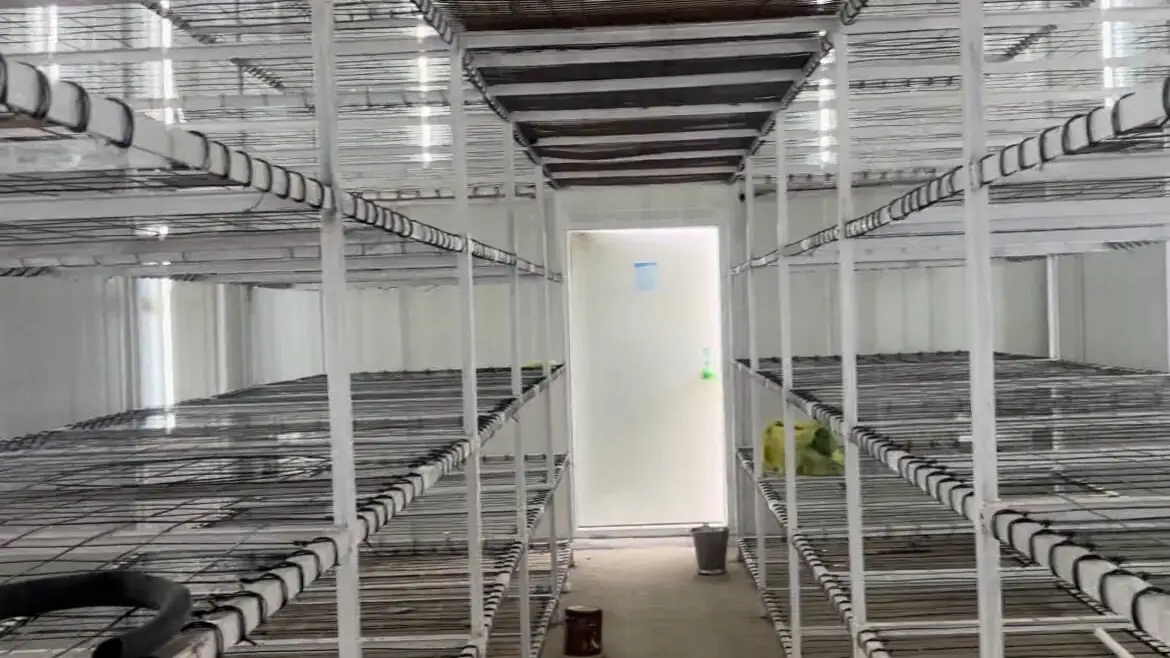
Compost Production SOP — Phase-1 and Phase-2 for Button Mushroom — India Setup Procedure & Equipment Cost
Mushroom compost SOP for Indian farms — 15–16 day cycle, Phase-1 bunker schedule, Phase-2 pasteurisation and conditioning, moisture, pH, costs and free PDF.
Composting SOP — in short
Mushroom compost is produced in two stages, in one cycle of 15–16 days from pre-wetting to spawning. After pre-wetting from Day 0 to Day 3, Phase-1 is an aerobic fermentation of wheat straw, chicken manure, gypsum and urea in aerated bunkers from Day 3 to Day 9, turned on Day 3, 5 and 7, producing a dark, ammoniacal, uniformly wet compost at 68–72% moisture. Phase-2 is an indoor controlled stage in a pasteurisation tunnel or room from Day 9 to Day 15: 6–8 hours at 58–60 °C to pasteurise, then 4–6 days of conditioning at 45–50 °C to convert free ammonia into microbial protein. Correctly finished Phase-2 compost is odour-free at below 10 ppm ammonia, 66–70% moisture and pH 7.2–7.8, and is cooled and spawned on Day 15–16.
Why this procedure matters
Compost is the single largest determinant of yield on a button mushroom farm. Two farms with identical grow rooms, identical racking and identical machinery will produce very different yields purely because one buys or makes better compost. Every rupee spent on climate control is wasted if the substrate entering the room is under-fermented, wet, or still carrying free ammonia.
This SOP describes the process MushroomWale specifies for integrated projects in India, where the raw material is normally wheat straw from Punjab, Haryana or western Uttar Pradesh, supplemented with poultry manure. It covers the full sequence from raw material intake through to Phase-2 compost ready for spawning, with the parameter windows, the turning schedule, the sampling protocol and the cost basis for each block.
Two commercial routes exist. Integrated farms build a wetting slab and Phase-1 bunkers plus a Phase-2 tunnel and control their own substrate quality and cost. Grower-only farms buy ready Phase-2 or spawned Phase-3 compost from a commercial composter. Both are legitimate: the integrated route lowers per-kilogram cost and removes supply risk, but adds capital, land, labour and process risk. This procedure is written for the integrated route, and the grower-only farm can still use the acceptance criteria section to inspect purchased compost before paying for it.
Follow the SOP in sequence. The most common failure on Indian farms is compressing Phase-1 to save days: the fermentation is biological, not mechanical, and a shortened Phase-1 cannot be rescued in Phase-2.
Step-by-step procedure
1. Raw material intake and quality check
Receive wheat straw in bales and store under cover on a raised, dry platform. Straw must be bright, dry, free of mould and not more than one season old. Poultry manure should be fresh broiler litter, not layer droppings with high grit content. Gypsum must be agricultural grade. Reject any consignment that is visibly mouldy or waterlogged, because contaminated straw carries competitor moulds through the entire cycle.
- Straw moisture at intake below 15%
- Poultry manure nitrogen 3.5–4.5% on dry basis
- Gypsum purity 85%+
2. Formulation and pre-wetting (Day 0 to Day 3)
Work to a formula giving a starting C:N ratio near 28–30:1 and a finishing ratio near 17:1. A widely used Indian formula per tonne of dry wheat straw is 400–500 kg poultry manure, 30 kg urea, 25 kg gypsum and 30 kg wheat bran. Spread the straw on the wetting slab, soak it with clean water over two to three days until fully saturated, turning it once daily so the wetting is uniform. Water penetration into the stem is the objective — surface wetting produces dry cores that never ferment.
- Moisture after pre-wetting 72–75%
- No dry straw cores when a handful is squeezed
3. Filling the aerated bunkers (Day 3)
Fill the aerated bunker to a height of 6–7 ft over its underfloor aeration: 4-inch PVC pipes in the floor, fed from the 8-inch HDPE manifold. The 20 T unit's bunkers are 14 × 30 ft and the 30 T unit's 14 × 40 ft. Layer the manure and supplements evenly as the bunker is filled rather than dumping them at one end. Do not compact the fill — Phase-1 is aerobic and a compacted core goes anaerobic within 48 hours, producing black, foul-smelling compost that must be discarded.
- Bunker core temperature reaches 70–75 °C within 48 hours
4. Phase-1 turning schedule (Day 3 to Day 9)
Turn on a fixed schedule, on Day 3, Day 5 and Day 7, moving the outside of the compost to the inside each time; between turnings the blowers run 5–10 minutes every 2 hours. Add gypsum at the second turning and the balance of water at each turning to hold moisture. Record the core temperature at three points before every turn. Phase-1 is complete when the compost is dark chocolate brown, the straw shears easily between the fingers, and the ammonia smell is strong but the material is uniform throughout.
- Core temperature 70–78 °C between turns
- Moisture 68–72% at the end of Phase-1
- Phase-1 runs from Day 3 to Day 9 of the 15–16 day cycle
5. Filling the Phase-2 tunnel (Day 9)
Fill the pasteurisation tunnel or shelf room evenly to a bed depth of 1.8–2.0 m, without compaction. Uneven filling is the main cause of temperature stratification in Phase-2. Insert calibrated probes at three depths and at least three horizontal positions before sealing the tunnel.
- Fill within 6 hours of emptying the bunkers
- Bed depth variation under 10 cm
6. Pasteurisation (Phase-2 part A)
Raise the compost temperature to 58–60 °C and hold it for 6–8 hours with continuous air recirculation and a controlled fresh-air fraction. This kills nematodes, mites, competitor mould spores and weed mushroom mycelium. Never exceed 62 °C — above that, the thermophilic microflora that consumes ammonia is destroyed, and the compost becomes selective for competitors instead of Agaricus.
- 58–60 °C compost temperature
- Hold 6–8 hours
- Air temperature never above 62 °C
7. Conditioning (Phase-2 part B)
Drop the compost to 45–50 °C and hold for 4–6 days with fresh air, allowing thermophilic actinomycetes to convert free ammonia into microbial protein. Reduce temperature by roughly 1 °C per day towards the end. Conditioning is finished when free ammonia is below 10 ppm — verifiable with a Drager tube or, as a field test, when a handful held to the nose has a sweet, bready smell with no ammonia sting.
- 45–50 °C for 4–6 days
- Ammonia below 10 ppm
- Visible white actinomycete growth through the compost
8. Cool-down and acceptance (Day 15–16)
Cool the compost to 25–26 °C before spawning. Take five samples across the tunnel and check moisture, pH and ammonia. Compost is accepted for spawning only if all five samples pass. Record the batch number, formula, Phase-1 duration, peak temperatures and acceptance results in the batch file — this record is what allows a yield problem to be traced back to a cause three cycles later.
- Spawning temperature 25–26 °C
- Moisture 66–70%
- pH 7.2–7.8
- Ammonia under 10 ppm
Operating parameters
| Parameter | Target | Tolerance | Note |
|---|---|---|---|
| Phase-1 core temperature | 70–78 °C | ±3 °C | Measured at 3 points before each turn |
| Phase-1 moisture | 70% | 68–72% | Squeeze test: 2–3 drops between fingers |
| Phase-1 duration | 6 days | Day 3–9 | Turnings on Day 3, 5 and 7; the whole cycle is 15–16 days |
| Pasteurisation temperature | 58–60 °C | never above 62 °C | Hold 6–8 hours |
| Conditioning temperature | 45–50 °C | ±2 °C | 4–6 days with fresh air |
| Free ammonia at finish | under 10 ppm | 0–10 ppm | Drager tube or smell test |
| Finished moisture | 68% | 66–70% | Wetter compost invites bacterial blotch |
| Finished pH | 7.5 | 7.2–7.8 | Below 7.0 indicates incomplete fermentation |
| Compost yield ratio | 1 t straw to ~2.5–3 t Phase-2 | ±0.3 t | Depends on formula and water retention |
Daily and per-cycle routine
- Record ambient temperature, bunker core temperature at three points and moisture observation every morning at 08:00.
- Photograph each bunker before and after every turning and file against the batch number.
- Check leachate drainage daily; standing leachate around the slab and bunkers breeds flies and re-infects the compost.
- Calibrate the temperature probes weekly against a reference thermometer.
- Wash and disinfect the loader bucket between the Phase-1 bunkers and the Phase-2 tunnel — this single step prevents most cross-contamination.
- Close the batch file at spawning with formula, durations, peak temperatures, acceptance results and the operator name.
Cost breakdown
What this workstream costs, how each item is measured, and where it sits in the overall project budget.
| Item | Costing basis | Cost band | Note |
|---|---|---|---|
| Wetting slab and Phase-1 bunkers (paved, sloped slab, leachate collection) | Per sqm of slab and bunker floor | Civil works — client scope | Sized on batch tonnage: a 45 × 50 ft slab for the 20 T unit or 45 × 70 ft for the 30 T, beside two 14 × 30 ft or 14 × 40 ft bunkers |
| Phase-2 tunnel / pasteurisation room | Per tonne of batch capacity | Largest compost-unit cost block | PUF-insulated envelope, plenum floor, ducting and controls |
| Steam generator / boiler | Per unit, sized on tunnel volume | Capital item | Diesel, briquette or electric depending on fuel availability |
| Air handling, recirculation fans and dampers | Per tunnel | Capital item | Fresh-air fraction control is what makes conditioning possible |
| Turning machinery / loader | Per unit | Capital or hired | Small farms hire a tractor-mounted turner; large farms own it |
| Wheat straw | Per tonne | Recurring | Largest recurring input; price is seasonal and peaks after Rabi |
| Poultry manure, urea, gypsum, bran | Per tonne of straw | Recurring | Roughly 0.5 t manure and 55 kg supplements per tonne of straw |
| Labour and fuel for Phase-1 | Per batch | Recurring | Turnings on Day 3, 5 and 7 plus watering |
Approx. planning guidance only. Live rates follow the current MushroomWale master rate version; quotations carry 5-day validity and a 5% market volatility clause.
GST @ 18% and Transportation are Extra
Civil works, boundary wall, site levelling, land and power sanction are Client Scope. Any additional work demanded beyond the agreed BOQ is treated as extra and charged separately.
Troubleshooting
| Problem | Likely cause | Corrective action |
|---|---|---|
| Compost is black, slimy and smells sour | Anaerobic core from over-compaction or over-watering | Empty the bunker, turn immediately, add dry straw to restore porosity. If more than a third of the batch is affected, discard it — anaerobic compost will not recover. |
| Bunker core never reaches 70 °C | Insufficient nitrogen, low moisture, or a bunker filled too shallow | Verify the manure and urea dosing, re-wet to 70%, and refill the bunker to its 6–7 ft height. A shallow fill loses heat faster than it generates it. |
| Ammonia still present at the end of conditioning | Conditioning too short, too hot, or with too little fresh air | Extend conditioning by 24–48 hours at 45–48 °C with increased fresh air. Never spawn ammoniacal compost — the spawn simply will not run. |
| Green mould appearing in the tunnel | Pasteurisation temperature not achieved through the whole bed | Review probe placement and fill uniformity; a cold pocket in the bed is almost always the cause. Re-pasteurise if detected early. |
| Compost too dry at spawning | Excessive evaporation during conditioning | Apply a fine water spray during the final turn into the tunnel, not after cool-down, so the water is absorbed rather than sitting on the surface. |
Records to maintain
How this SOP fits mushroom farming setup in India
Mushroom farming setup in India splits into two halves — what you build, and what you run. The build is the insulated grow room, 7-tier racking, refrigeration, fresh-air handling, power and the packhouse. The run is exactly the set of SOPs in this library. The two are locked together: the setpoints in these procedures decide the machine capacity you must buy, and the bed area decides compost tonnage, spawn quantity and achievable yield.
That is why mushroom farming equipment cost can only be estimated once room size, room count, bed area and the site's peak summer temperature are fixed. Any single "cost per room" number quoted without those inputs is misleading — an 18×30 ft room and an 18×60 ft room differ in panel area, racking metres and machine tonnage, and the same room in a hotter district needs a larger machine to hold 16–18 °C during cropping.
The table below shows how each head is measured, so you can sanity-check any quotation you receive. Live rates follow the current MushroomWale master rate version, quotations carry 5-day validity, and GST @ 18% plus transportation are extra.
| Cost head | Measured on | What drives it |
|---|---|---|
| Insulated grow room shell (PUF panels, doors, structure) | Per sq ft of built-up room area | The single largest civil-adjacent head; wall panels 60 mm, roof panels 80 mm, PPGL coated |
| 7-tier MS racking system | Per sq m of bed area | Defines bed area, and therefore compost tonnage, spawn quantity and yield |
| Refrigeration and air handling | Per room, sized on peak summer load | Sized on the location's peak temperature and crop heat load, never on the annual average |
| Fresh air, ducting and controls | Per room | Air cloth duct, mixing chamber, dampers, sensors and the stage-wise controller profile |
| Compost unit (wetting slab and Phase-1 bunkers + Phase-2 tunnel) | Per tonne of batch capacity | Only for integrated farms; grower-only farms buy Phase-2 or Phase-3 compost instead |
| Power infrastructure and DG backup | Per kVA | Sized with starting surge and diversity factor across rooms |
| Packhouse and cold room | Per sq ft + per TR | Pre-cooling to 2–4 °C within 30 minutes is what protects 5–7 day shelf life |
Equipment catalogue
Buy every item used in this SOP
One page with the image, working specification, HSN code, minimum order quantity and live price for each SKU — with a direct buy button. GST and transportation extra.
Download this SOP as a printable PDF
Full procedure, parameter table, cost breakdown, troubleshooting and record sheet — formatted for the farm noticeboard. No form required.
Applying this SOP on your own farm?
Send your details and our project engineer will review your SOP fit, share an itemised cost sheet for your farm size and answer questions on WhatsApp — free.
SOP read: Compost Production SOP — Phase-1 and Phase-2 for Button Mushroom (Composting)
Frequently asked questions
Other SOPs in this library
Continue the guide series
Why Choose MushroomWale
- 01
Engineering Expertise
Agrimotion Engineering Private Limited is a registered EPC company (CIN U43900UP2023PTC185328, GSTIN 09AAZCA0158R1ZP) based in Firozabad, Uttar Pradesh.
- 02
Proven Track Record
Turnkey mushroom projects from a 2-room starter to a 20-room commercial farm.
- 03
Bank-Recognized DPRs
Bank-format DPRs prepared to NABARD, NHB and MIDH norms for loan and subsidy applications.
Ready to Build Your Mushroom Farm?
Get a free site survey and a custom quote within 24 hours.
- Turnkey farms built
- Pan-India delivery
- Bank-ready DPR