
Climate Control SOP — Temperature, Humidity, CO₂ and Airflow — India Setup Procedure & Equipment Cost
Mushroom grow room climate control SOP — stage-wise temperature, RH and CO₂ setpoints, airflow and fresh-air design, sensor calibration, costs and PDF.
Environment SOP — in short
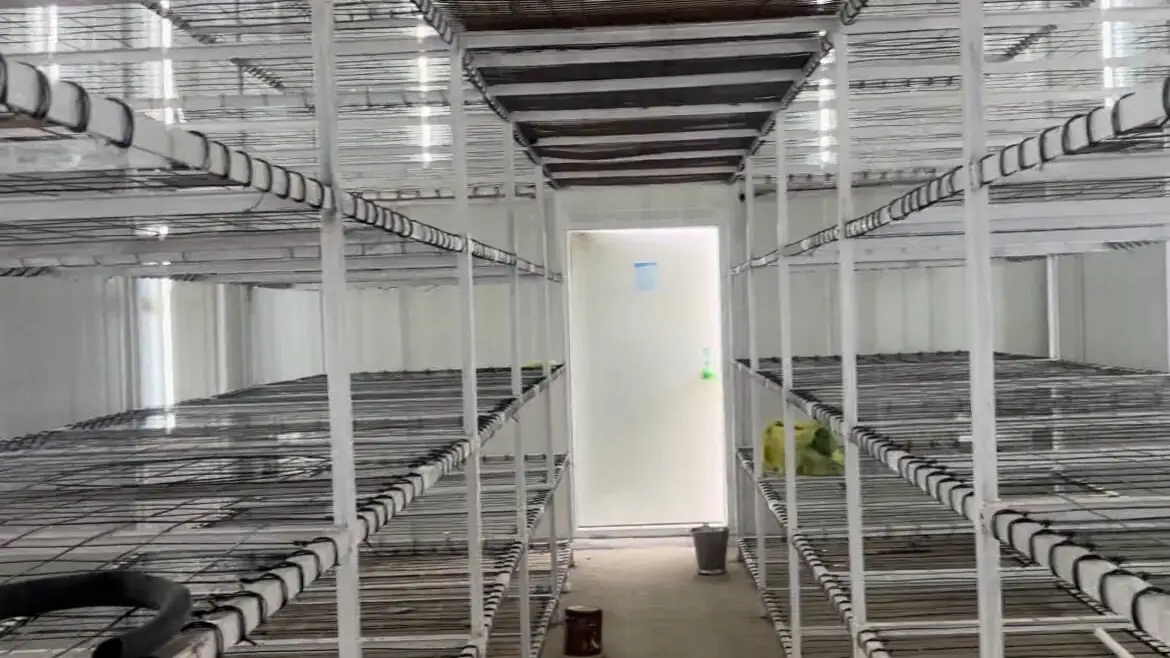
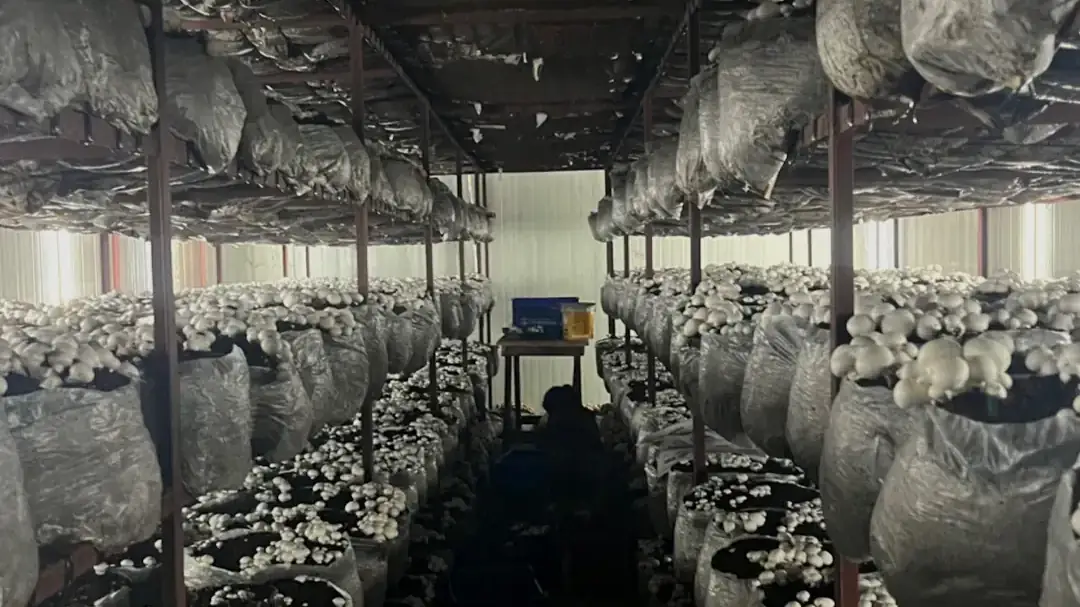
A button mushroom grow room is run to three stage-wise setpoint groups. Spawn run: air 22–24 °C, RH 90–95%, CO₂ 5,000–15,000 ppm, minimal fresh air. Case run: air 24–25 °C, RH 92–95%, CO₂ 5,000–10,000 ppm. Cropping: air 16–18 °C, RH 85–90%, CO₂ below 1,000 ppm with fresh air at roughly 5–8 m³/hour per square metre of bed. Air is delivered through ducting above the racks so that every one of the 7 tiers sees the same conditions.
Why this procedure matters
Climate control is where a mushroom farm either makes or loses its margin. The crop's biological potential is fixed by compost and spawn; the climate system determines how much of that potential is actually harvested, and it does so in a country where ambient temperature swings from 4 °C to 47 °C across the year.
The engineering objective is not to reach a setpoint. It is to hold that setpoint uniformly across a room that is 18 feet wide, has seven tiers of beds, and contains a crop that is generating its own heat and its own CO₂ at a rate that changes daily. A machine that can hit 17 °C but cannot hold ±1 °C across all tiers will produce three different crops in the same room.
This SOP defines the setpoint schedule, the airflow and fresh-air design basis, the sensor and calibration discipline, and the cost structure of the climate package. It reflects the MushroomWale standard build: PUF-panelled rooms with PPGL coating, an AHU per room, Daikin refrigeration as default with Carrier R-404a available on 18×40, 18×60 and 18×70 rooms, ultrasonic humidification and controlled fresh-air blowers.
Step-by-step procedure
1. Establish the design basis before buying machinery
Size the plant on peak ambient for your district, not on the annual average. The heat load is the sum of transmission through the PUF envelope, fresh-air load, the crop's own respiration heat, lighting, people and door openings. Under-sizing shows up only in May and June — exactly when the market price is highest — so the buffer belongs in the design, not in the operating manual.
- Sized on district peak ambient
- Crop respiration heat included in the load
- Starting-surge buffer included in DG sizing
2. Build a sealed, insulated envelope
Climate control is impossible in a leaky room. Specify PUF panels with PPGL coating on walls and roof, sealed panel joints, insulated doors with functioning gaskets, sealed cable and pipe penetrations, and drain traps that hold water. A room that leaks air also leaks spores and flies in the opposite direction.
- All joints sealed
- Door gaskets intact
- Drain traps water-filled at all times
3. Install air distribution for 7-tier uniformity
Deliver conditioned air through overhead ducting with adjustable outlets so air is thrown along the length of the room and returns through the rack spaces. The design target is uniform velocity across every tier without blowing directly onto the beds, which dries caps and causes scaling. Commission the ducting by measuring velocity at the first, middle and last outlet and balancing the dampers.
- Velocity variation between outlets under 15%
- No direct airflow onto bed surfaces
4. Set up sensors and the controller
Install air temperature, compost temperature, RH and CO₂ sensors per room, with compost probes at three tiers. Set the controller to stage-based recipes rather than manual setpoints, so an operator changing a shift does not change the crop. Log at four-hour intervals minimum; hourly is better and costs nothing once a datalogger is installed.
- Compost probes at 3 tiers
- CO₂ sensor per room
- Automatic logging enabled
5. Run the spawn run climate stage
Air 22–24 °C, RH 90–95%, CO₂ 5,000–15,000 ppm, fresh air near zero. Track compost temperature, not air temperature, as the controlling variable, because the crop's self-heating of 2–3 °C is what actually determines whether the mycelium is stressed. Lower the air setpoint progressively from Day 4 as the heat load builds.
- Compost 24–25 °C, never above 28 °C
- Fresh air minimal
6. Run the case run climate stage
Air 24–25 °C, RH 92–95%, CO₂ 5,000–10,000 ppm. Humidity is the priority here: the casing layer must never dry, and the humidifier should be running in short frequent cycles rather than long ones, which cause wet surfaces and blotch.
- RH 92–95% held continuously
- Short humidifier cycles
7. Execute the airing-down ramp
Move from case run to cropping over 24–48 hours: air 24 °C to 17–18 °C, CO₂ from above 5,000 ppm to below 1,000 ppm, RH to 88–92%. Fresh-air requirement rises sharply here to roughly 5–8 m³/hour per square metre of bed. This is the peak simultaneous demand on both the refrigeration and the fresh-air system, and it is the load case that should have sized the plant.
- Controlled ramp, not a step change
- CO₂ under 1,000 ppm at the end of the ramp
8. Hold the cropping stage and manage flushes
Air 16–18 °C, RH 85–90%, CO₂ under 1,000 ppm during flushes. CO₂ and respiration heat peak with each flush and fall between flushes, so the fresh-air fraction should follow the crop rather than sit at a fixed value. Between flushes, RH can be held slightly higher to help the casing recover after watering.
- Air 16–18 °C ±1 °C across all tiers
- CO₂ under 1,000 ppm during flush
9. Weekly maintenance and calibration
Clean AHU filters weekly, check condensate drainage, verify refrigerant pressures monthly, calibrate CO₂ sensors quarterly against a reference meter, and verify temperature probes against a calibrated thermometer monthly. A drifting CO₂ sensor is the most common invisible cause of a poor pin set, because the controller believes the room is aired when it is not.
- Weekly filter clean
- Monthly probe verification
- Quarterly CO₂ calibration
Operating parameters
| Parameter | Target | Tolerance | Note |
|---|---|---|---|
| Spawn run air temperature | 22–24 °C | ±1 °C | Compost held at 24–25 °C |
| Spawn run RH | 90–95% | ±3% | Minimal fresh air |
| Spawn run CO₂ | 5,000–15,000 ppm | up to 20,000 | High CO₂ is desirable at this stage |
| Case run air temperature | 24–25 °C | ±1 °C | Same as spawn run |
| Case run RH | 92–95% | ±3% | Highest humidity of the cycle |
| Cropping air temperature | 16–18 °C | ±1 °C | Lower gives firmer, whiter caps and slower growth |
| Cropping RH | 85–90% | ±2% | Above 92% invites bacterial blotch |
| Cropping CO₂ | under 1,000 ppm | 600–1,000 ppm | Above 1,500 ppm gives long stems and open caps |
| Fresh air during cropping | 5–8 m³/h per sqm bed | varies with flush | Peak demand at airing down and flush peak |
| Air velocity over beds | gentle circulation | no direct impingement | Direct airflow causes cap scaling |
Daily and per-cycle routine
- Read and log air temperature, compost temperature, RH and CO₂ every four hours in every room.
- Walk each room daily and confirm the controller reading against a handheld meter at the far tier.
- Clean AHU filters weekly and record the date on the unit.
- Check condensate trays and drain traps weekly for blockage and standing water.
- Verify temperature probes monthly and CO₂ sensors quarterly against a reference instrument.
- Record every setpoint change with the reason, the operator and the timestamp — unexplained setpoint drift is a common cause of crop variability.
- Log DG run hours and any power interruption longer than 15 minutes against the affected rooms.
Cost breakdown
What this workstream costs, how each item is measured, and where it sits in the overall project budget.
| Item | Costing basis | Cost band | Note |
|---|---|---|---|
| PUF panels, walls and roof (PPGL coated) | Per sqm of panel area | Largest single equipment block | 60/80 mm wall thickness; roof panel rated separately |
| Refrigeration unit per room | Per room by size (18×30 / 18×40 / 18×60 / 18×70 ft) | Second largest block | Daikin default; Carrier R-404a available on 18×40, 18×60 and 18×70 |
| AHU, ducting, grilles and dampers | Per room | Capital | Determines tier-to-tier uniformity — do not value-engineer this |
| Ultrasonic humidification | Per room | Capital | Sized on room volume and target RH |
| Fresh air blowers and filtration | Per room | Capital | Sized on 5–8 m³/h per sqm of bed at peak |
| Sensors and controller | Per room | Capital, moderate | Air and compost temperature, RH, CO₂ with logging |
| Electricals, panels and cabling | Per project | Capital | Sized on connected load |
| DG set | Per project | Capital | Sized on connected load plus starting-surge buffer |
| Running power | Per unit of electricity | Largest recurring operating cost after compost | Refrigeration dominates; peak in summer months |
Approx. planning guidance only. Live rates follow the current MushroomWale master rate version; quotations carry 5-day validity and a 5% market volatility clause.
GST @ 18% and Transportation are Extra
Civil works, boundary wall, site levelling, land and power sanction are Client Scope. Any additional work demanded beyond the agreed BOQ is treated as extra and charged separately.
Troubleshooting
| Problem | Likely cause | Corrective action |
|---|---|---|
| Temperature differs between top and bottom tiers | Poor air distribution or unbalanced dampers | Re-balance duct outlets and measure velocity at first, middle and last outlet. Never solve this by lowering the setpoint. |
| RH will not hold above 85% | Undersized humidifier, excessive fresh air, or a leaking envelope | Check door seals and penetrations first — envelope leakage is the usual cause and no humidifier can overcome it. |
| CO₂ reading stays flat regardless of fresh air | Drifted or failed sensor | Verify against a handheld reference meter and recalibrate. A flat reading is almost always instrumentation, not biology. |
| Long stems and open caps | CO₂ too high during cropping | Increase fresh air until CO₂ is reliably below 1,000 ppm during flush peak. |
| Machine runs continuously and never reaches setpoint in May–June | Plant undersized for peak ambient | Confirm against the original load calculation. If the design used average ambient, the room is capacity-limited in summer and needs supplementary cooling. |
| Water dripping from ducts onto beds | Uninsulated duct sections condensing | Insulate the affected run and check that condensate trays drain freely. |
Records to maintain
How this SOP fits mushroom farming setup in India
Mushroom farming setup in India splits into two halves — what you build, and what you run. The build is the insulated grow room, 7-tier racking, refrigeration, fresh-air handling, power and the packhouse. The run is exactly the set of SOPs in this library. The two are locked together: the setpoints in these procedures decide the machine capacity you must buy, and the bed area decides compost tonnage, spawn quantity and achievable yield.
That is why mushroom farming equipment cost can only be estimated once room size, room count, bed area and the site's peak summer temperature are fixed. Any single "cost per room" number quoted without those inputs is misleading — an 18×30 ft room and an 18×60 ft room differ in panel area, racking metres and machine tonnage, and the same room in a hotter district needs a larger machine to hold 16–18 °C during cropping.
The table below shows how each head is measured, so you can sanity-check any quotation you receive. Live rates follow the current MushroomWale master rate version, quotations carry 5-day validity, and GST @ 18% plus transportation are extra.
| Cost head | Measured on | What drives it |
|---|---|---|
| Insulated grow room shell (PUF panels, doors, structure) | Per sq ft of built-up room area | The single largest civil-adjacent head; wall panels 60 mm, roof panels 80 mm, PPGL coated |
| 7-tier MS racking system | Per sq m of bed area | Defines bed area, and therefore compost tonnage, spawn quantity and yield |
| Refrigeration and air handling | Per room, sized on peak summer load | Sized on the location's peak temperature and crop heat load, never on the annual average |
| Fresh air, ducting and controls | Per room | Air cloth duct, mixing chamber, dampers, sensors and the stage-wise controller profile |
| Compost unit (wetting slab and Phase-1 bunkers + Phase-2 tunnel) | Per tonne of batch capacity | Only for integrated farms; grower-only farms buy Phase-2 or Phase-3 compost instead |
| Power infrastructure and DG backup | Per kVA | Sized with starting surge and diversity factor across rooms |
| Packhouse and cold room | Per sq ft + per TR | Pre-cooling to 2–4 °C within 30 minutes is what protects 5–7 day shelf life |
Equipment catalogue
Buy every item used in this SOP
One page with the image, working specification, HSN code, minimum order quantity and live price for each SKU — with a direct buy button. GST and transportation extra.
Download this SOP as a printable PDF
Full procedure, parameter table, cost breakdown, troubleshooting and record sheet — formatted for the farm noticeboard. No form required.
Applying this SOP on your own farm?
Send your details and our project engineer will review your SOP fit, share an itemised cost sheet for your farm size and answer questions on WhatsApp — free.
SOP read: Climate Control SOP — Temperature, Humidity, CO₂ and Airflow (Environment)
Frequently asked questions
Other SOPs in this library
Continue the guide series
Why Choose MushroomWale
- 01
Engineering Expertise
Agrimotion Engineering Private Limited is a registered EPC company (CIN U43900UP2023PTC185328, GSTIN 09AAZCA0158R1ZP) based in Firozabad, Uttar Pradesh.
- 02
Proven Track Record
Turnkey mushroom projects from a 2-room starter to a 20-room commercial farm.
- 03
Bank-Recognized DPRs
Bank-format DPRs prepared to NABARD, NHB and MIDH norms for loan and subsidy applications.
Ready to Build Your Mushroom Farm?
Get a free site survey and a custom quote within 24 hours.
- Turnkey farms built
- Pan-India delivery
- Bank-ready DPR