
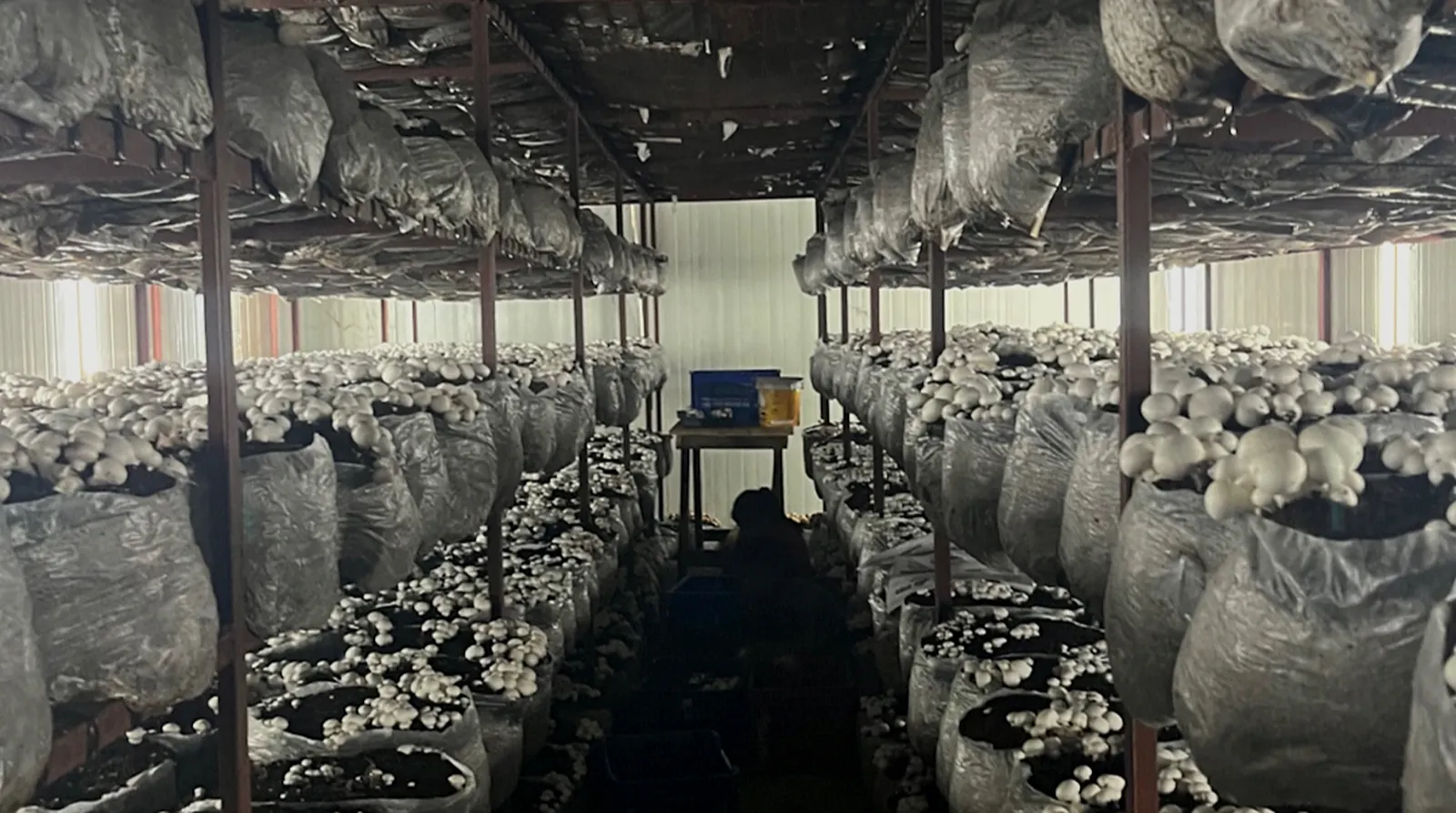
How to Grow Mushrooms in India (2026) — Step-by-Step Guide for Beginners
A practical, India-specific method for growing button, oyster and milky mushrooms — the exact climate windows, substrate recipes and equipment MushroomWale™ commissions on its own farms in Uttar Pradesh, Maharashtra, Punjab and Bihar.
How Do You Grow Mushrooms?
To grow mushrooms you pasteurise a substrate (composted wheat straw for button, paddy straw for oyster), mix in certified grain spawn, and let the mycelium colonise in the dark — 22–24 °C air for button mushroom over 12–16 days. For button mushroom you then add a 4–5 cm casing layer, run it 7–10 days at 24–25 °C, and bring air down to 17–18 °C with 88–92% humidity and CO₂ under 1,000 ppm to trigger pinning. First harvest comes in about 30–37 days for button mushroom and 20-25 days for oyster, with flushes every 7–10 days across a 60-day crop.
Growing at commercial scale? Skip the trial-and-error with a turnkey mushroom farm setup
The 8 Steps of Growing Mushrooms
Choose the mushroom and the season
Button mushroom (Agaricus bisporus) needs 16–18 °C for cropping and sells at the highest volume. Oyster (Pleurotus) grows at 22-28°C with the lowest investment. Milky mushroom (Calocybe indica) suits warm South Indian summers at 30-35°C. Beginners with no climate control should start with oyster; anyone planning year-round supply needs an AC-controlled room.
Prepare or buy the substrate
Button mushroom uses composted wheat straw: Phase-I fermentation in aerated bunkers for 6 days (Day 3–9 of a 15–16 day cycle) with the core at 70–78 °C, then Phase-II pasteurisation at 58–60 °C (hold 6–8 hours) and 4–6 days of conditioning at 45–50 °C until free ammonia is under 10 ppm. Oyster uses chopped paddy/wheat straw pasteurised in hot water at 65-70°C for 45-60 minutes. Phase-I compost moisture is 68–72% — a squeeze should leave the hand damp but not dripping.
Spawn the substrate
Use certified grain spawn at 0.5–0.75% of wet compost weight for button mushroom, and 2-3% of wet substrate weight for oyster. Spawn button compost at 25 °C (never spawn above 27 °c). Mix through the whole depth for button beds; layer it for oyster bags.
Spawn run (colonisation)
For button mushroom hold air at 22–24 °C, compost at 24–25 °C, RH 90–95%, and let CO₂ build to 5,000–15,000 ppm. Button mushroom colonises in 12–16 days, oyster in 15-20 days. Keep the room dark with minimal fresh air at this stage.
Casing and case run (button mushroom only)
Apply a 4–5 cm layer of pasteurised casing (coco peat with FYM or spent compost plus lime, pH 7.5–7.8). Hold 24–25 °C, RH 92–95% and CO₂ 5,000–10,000 ppm for 7–10 days until mycelium reaches the casing surface, then ruffle if your protocol uses it.
Pinning — drop the temperature and CO₂
This is the step most beginners get wrong. Bring air down to 17–18 °C (ramp over 24–48 hours), raise fresh air so CO₂ falls under 1,000 ppm, hold RH at 88–92%. Pins appear 5–7 days after airing. Without a fresh-air blower and a CO₂ sensor this stage is guesswork.
Cropping, harvest and flushes
Hold 16–18 °C, RH 85–90%, CO₂ under 1,000 ppm. Harvest button mushrooms as closed caps before the veil breaks (25–45 mm by grade); twist, do not cut. First harvest comes 18–21 days after casing, then a flush every 7–10 days — 3 flushes in a 60-day crop. Expect about 200 kg per tonne of compost over the crop (2 kg per 10 kg bag), or 18–22 kg per m² of bed.
Post-harvest and sale
Pre-cool to a product core of 2–4 °C under 30 minutes of picking, pack in 200 g/500 g punnets or 5 kg crates, and move in an insulated vehicle. Shelf life is 5–7 days at 2–4 °C and much shorter without it — the cold chain is what lets you sell beyond the local mandi.
Climate Targets by Stage (Button Mushroom)
| Stage | Air Temp | RH | CO2 | Light |
|---|---|---|---|---|
| Spawn run | 22–24 °C | 90–95% | 5,000–15,000 ppm | Dark |
| Case run | 24–25 °C | 92–95% | 5,000–10,000 ppm | Dark |
| Pinning | 17–18 °C | 88–92% | under 1,000 ppm | Low |
| Cropping | 16–18 °C | 85–90% | under 1,000 ppm | Low |
| Post-harvest | 2–4 °C | 90–95% | Ambient | Low |
Sizing method behind these numbers is published on our engineering data pages — including CO2 and fresh air requirement.
What You Need to Buy
Growing racks
7-tier MS racks decide yield per sq ft
PUF panels & doors
PPGL panels (60/80 mm walls, 80/110 mm roof) hold 16–18 °C economically
Humidifier
Ultrasonic/centrifugal units for 85–90% RH while cropping
Fresh air blower & dampers
Only way to pull CO₂ under 1,000 ppm at pinning
CO₂ meter & sensor rod
Pinning is controlled by CO₂, not by guesswork
Spawn, casing, crates
Consumables for every cycle
Everything above is stocked in the MushroomWale online shop with GST invoice and PAN India despatch. Prices exclude GST @ 18% and transport.
Related Reading
Frequently Asked Questions
Why Choose MushroomWale
- 01
Engineering Expertise
Agrimotion Engineering Private Limited is a registered EPC company (CIN U43900UP2023PTC185328, GSTIN 09AAZCA0158R1ZP) based in Firozabad, Uttar Pradesh.
- 02
Proven Track Record
Turnkey mushroom projects from a 2-room starter to a 20-room commercial farm.
- 03
Bank-Recognized DPRs
Bank-format DPRs prepared to NABARD, NHB and MIDH norms for loan and subsidy applications.
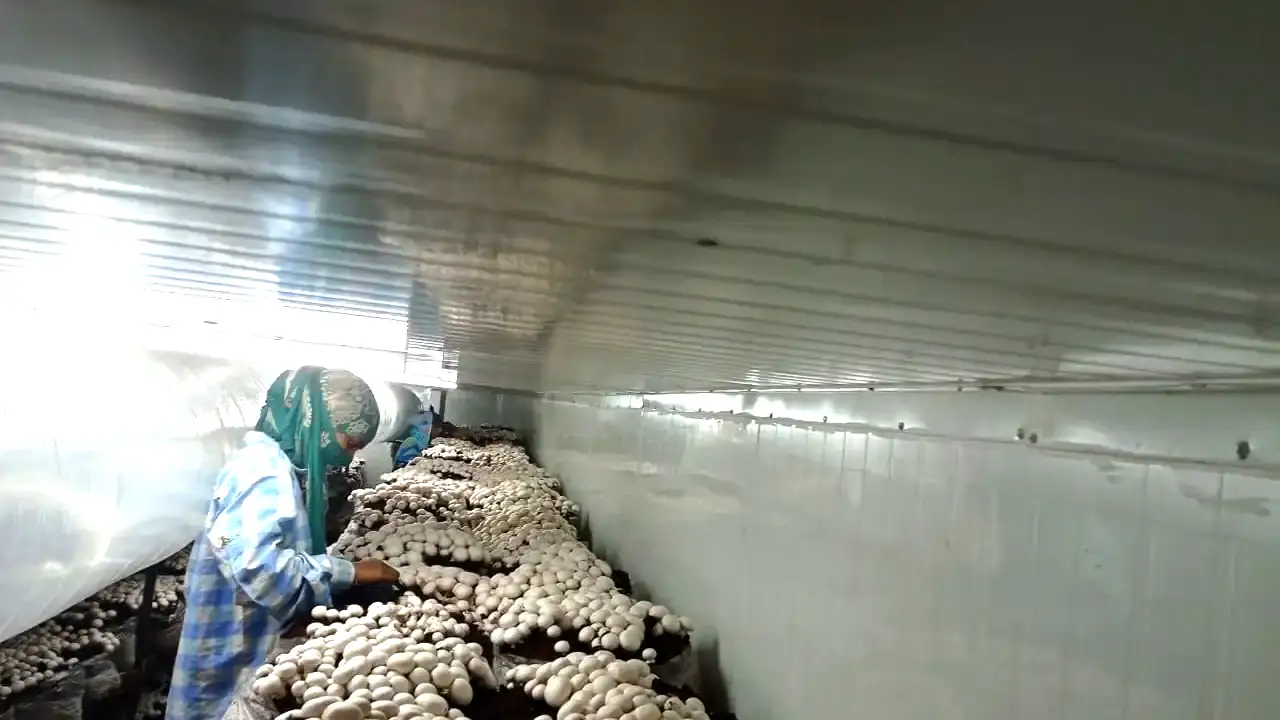
Grow Mushrooms Year-Round, Not Just in Winter
Get a free room-wise quote for a climate-controlled growing room and compost unit.
- Turnkey farms built
- Pan-India delivery
- Bank-ready DPR