
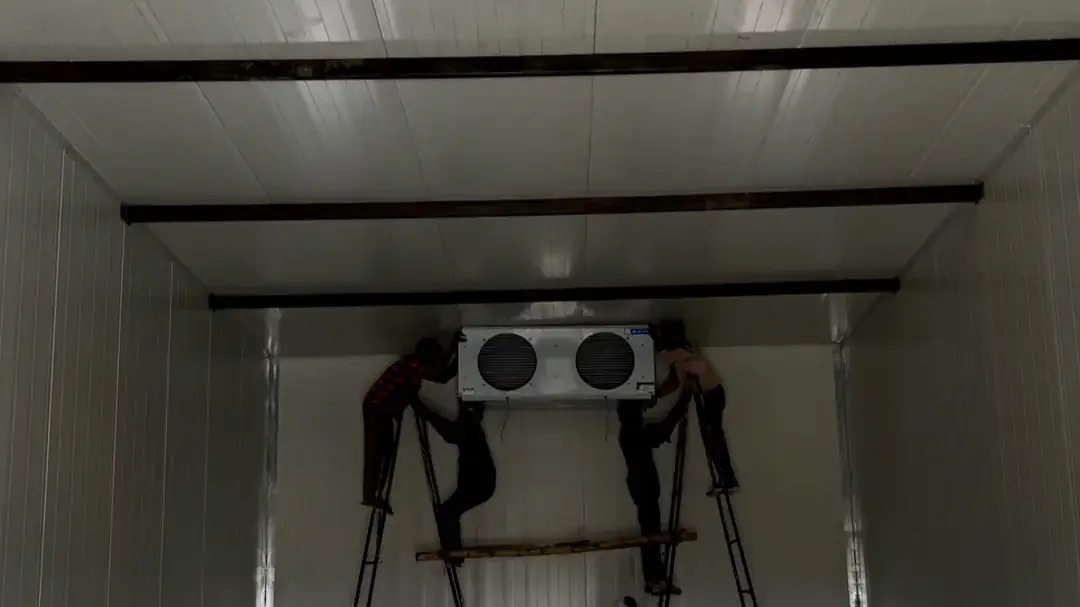
Climate Control & Cooling
Temperature, humidity, CO₂, fresh air, exhaust, air distribution, DX cooling, chiller-based cooling, and Daikin HMT systems.
A button mushroom room is a process chamber, not an air-conditioned office. Four parameters have to be held together: temperature, relative humidity, CO₂ and air movement. Controlling one while ignoring the others is the most common engineering failure in Indian mushroom projects.
Each crop stage has its own target band. Spawn run needs warmer, high-CO₂, high-humidity conditions. After casing, the room is cooled and ventilated to trigger pinning. During cropping, temperature is held steady and fresh air is increased to keep CO₂ down. Swings between these stages, or drift within a stage, show up directly as uneven pinning, long stalks, open caps and lost grade.
MushroomWale supplies Daikin HMT systems as default, sized per room model: 6 TR outdoor for 18×30 ft, 8 TR for 18×40 ft, 10 TR for 18×60 ft and 12 TR for 18×70 ft, each paired with an HMT evaporator indoor unit with a 550 mm fan. Carrier (Haier-CCR, R-404a commercial refrigeration) is offered as an alternative on 18×40, 18×60 and 18×70 rooms. DX systems suit single and small multi-room farms; chiller-based plants use 3–9% less electricity per kilogram in MushroomWale's engineering study but cost more to build, so on capital plus ten years of electricity DX still wins at 500 and 1,000 kg/day and ammonia at 5,000; the three are compared design by design at /comparisons/dx-vs-chiller-vs-ammonia-mushroom-plant.
A comfort split AC cannot do this job. It is sized for sensible cooling of a lightly loaded space, dries the air instead of holding 85–92% RH, has no fresh-air or CO₂ strategy, and is not built for continuous duty against a live crop heat load. Installing one is a false economy that usually ends in early compressor failure and poor crops.
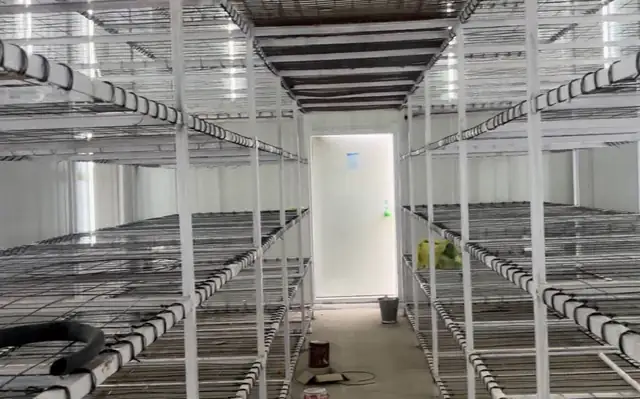
Air distribution is as important as tonnage. Conditioned air is delivered through an air mixing chamber and cloth/duct distribution so every rack tier receives even flow, with fresh air and exhaust dampers controlling CO₂. Filters protect the crop from airborne spores and dust.
Insulation and power close the loop. PUF panels — 80 mm PPGL external walls, 60 mm PPGL common walls and PPGL roof panels — keep the calculated load real. Backup power must cover the full running scenario of cooling, humidification and fans together, or the design capacity is theoretical.
Continue Learning
 Engineering
Disease & Hygiene Control
How contamination, green mould, bacterial issues, poor hygiene, casing mistakes, and wrong airflow damage production.Start Learning Beginner
Beginner Mushroom Farming
Understand whether mushroom farming is right for you, required land, budget, labour, power, water, crop options, risk factors, and first-step planning.Start Learning Commercial