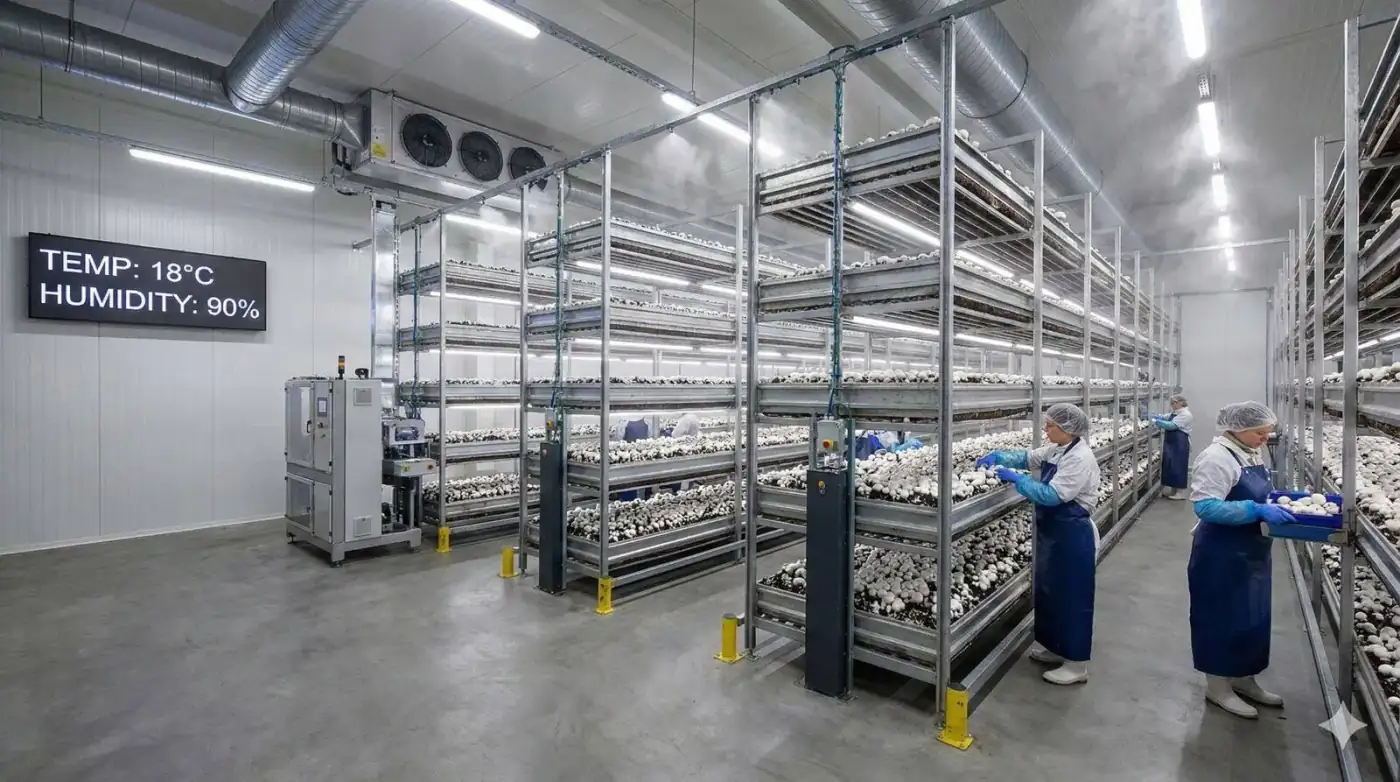
Mushroom Compost Unit Setup
Mushroom compost unit setup with Phase-I composting yard and Phase-II pasteurisation tunnels, boiler, airflow and controls. Standalone or integrated with grow rooms.
Frequently asked questions
Is a compost unit part of a full mushroom production unit or project?
Yes. In a complete mushroom production unit, the compost unit feeds substrate directly to the grow rooms, so we usually design it as part of one turnkey mushroom project — compost unit, grow rooms, cold room and HVAC engineered together. You can also build the compost unit standalone and integrate grow rooms later.
What is a compost unit for mushroom farming?
A mushroom compost unit is the infrastructure for preparing mushroom growing substrate (compost). It includes Phase-1 composting yard for outdoor decomposition and Phase-2 pasteurization tunnels with steam boilers for pathogen elimination. Quality compost is the foundation of profitable Agaricus bisporus (button mushroom) farming.
How much does a mushroom compost unit cost in India?
Compost units range from ₹15-50 lakhs depending on capacity and automation level. A 10-ton/batch Phase-2 tunnel with boiler costs approximately ₹20-25 lakhs. Complete Phase-1 + Phase-2 integrated units for commercial farms start at ₹30 lakhs. Use our Design Generator for project-specific pricing.
Should I make my own compost or buy it?
Self-made compost costs ₹65-75 per 10kg bag vs. ₹95-110 for purchased compost — a 40% saving. If you plan more than 3 grow rooms, self-composting is significantly more economical. MushroomWale designs integrated farm layouts with both grow rooms and compost units for maximum efficiency.
What raw materials are needed for mushroom compost?
Button mushroom (Agaricus bisporus) compost requires wheat straw, chicken manure, gypsum, urea, and water. The Phase-1 process takes 12-14 days of outdoor composting with 6-7 turnings, followed by 6-8 days of Phase-2 pasteurization at 58-62°C in insulated tunnels. ICAR-DMR provides detailed formulation guidelines.
What is the difference between Phase-1 and Phase-2 composting?
Phase-1 is outdoor composting where raw materials decompose over 12-14 days with regular turning using machinery. Phase-2 happens in sealed PUF-insulated pasteurization tunnels at 58-62°C using steam from a boiler, which eliminates harmful organisms (nematodes, competitor moulds) and conditions the compost for spawning.
Can I add a compost unit to an existing mushroom farm?
Yes, compost units can be added independently. MushroomWale designs the layout to maintain proper distance from grow rooms (minimum 50 meters recommended by ICAR-DMR) to prevent contamination. Integration with existing infrastructure is seamless.
What capacity compost unit do I need for a 10-room farm?
A 10-room farm (18×40 ft rooms, ~500 bags each) needs approximately 50 tonnes of fresh compost per cycle. A Phase-2 tunnel capacity of 25-30 tonnes per batch with 2 batches per cycle is recommended. This requires a Phase-1 yard of approximately 3,000-4,000 sq ft.
What type of boiler is used for Phase-2 tunnels?
MushroomWale installs wood/coal/biomass fired steam boilers sized for the tunnel capacity. A 10-ton tunnel typically needs a 200-300 kg/hr boiler. Automatic temperature controls maintain the 58-62°C pasteurization range with ±1°C precision.
How long does Phase-2 pasteurization take?
The standard Phase-2 cycle takes 6-8 days: 1 day for filling and peak heating, 6-8 hours of pasteurization at 58-60°C, 4-5 days of conditioning at 48-52°C for beneficial thermophilic microorganism growth, and 1 day for cool-down before spawning.
Is government subsidy available for compost unit construction?
Yes, compost units qualify for 35-50% subsidy under MIDH, NHB (National Horticulture Board), NABARD, and state horticulture missions. MushroomWale prepares integrated DPRs that include compost infrastructure for maximum subsidy coverage.
Can oyster mushroom substrate be prepared in these units?
Phase-2 tunnels designed for button mushroom compost can also be used for oyster mushroom (Pleurotus ostreatus) substrate pasteurization. The process is simpler — straw is soaked, filled in the tunnel, and pasteurized at 65-70°C for 6-8 hours. No Phase-1 outdoor composting is needed for oyster substrate.
What is the break-even point for building your own compost unit?
With compost cost savings of ₹25-35 per bag and production of 5,000+ bags per cycle, a compost unit typically pays for itself within 8-14 months. For farms with 6+ rooms, the ROI on self-composting is significantly better than buying compost long-term.
Get Instant Quotation WhatsApp +91 75799 97333
What we build
- Grow Rooms — insulated PUF rooms with rack systems, 100 kg/day to 1 ton/day
- Compost Units — Phase-1 bunkers & Phase-2 pasteurisation tunnels
- Turnkey Farm Setup & EPC contracts
- ROI & cost calculators and sample DPR for bank loan
- NHB, MIDH, NABARD & PMEGP subsidy guidance
- Cultivation training in English & Hindi
Contact MushroomWale
AgriMotion Engineering Pvt Ltd, Sirsaganj, Firozabad, Uttar Pradesh 283151, India.
Phone: +91 75799 97333 · +91 84396 56800 · +91 75995 43434
This is a static summary. Enable JavaScript for the full interactive experience, or read the plain-text summary.